You’ve been doing great with Russian. You can order coffee, ask for directions, maybe even complain about the weather like a local. Then you try to say “two beers” and suddenly it’s like the language flipped a switch. Two beers? Два пива (dva piva). Five beers? Пять пив (pyat’ piv). Wait, why did the beer word change? And why does “one beer” look completely different again?
What kind of player are you really?
This is the moment most learners hit a wall. The 1, 2-4, 5+ rule for plurals and numbers in Russian feels like a secret handshake nobody told you about. But here’s the truth: it’s not random. It’s a pattern that, once you see it, makes you sound instantly more natural. And no, you don’t need to memorize a hundred endings. You just need to understand the logic.
Let’s break it down like we’re sitting in a Warsaw café, not a classroom.
Why the number matters, not the noun
In English, you say “one cat, two cats, five cats.” The noun changes once, and you’re done. Russian does something different. The number itself decides what form the noun takes. Think of it as the number being the boss, and the noun just follows orders.
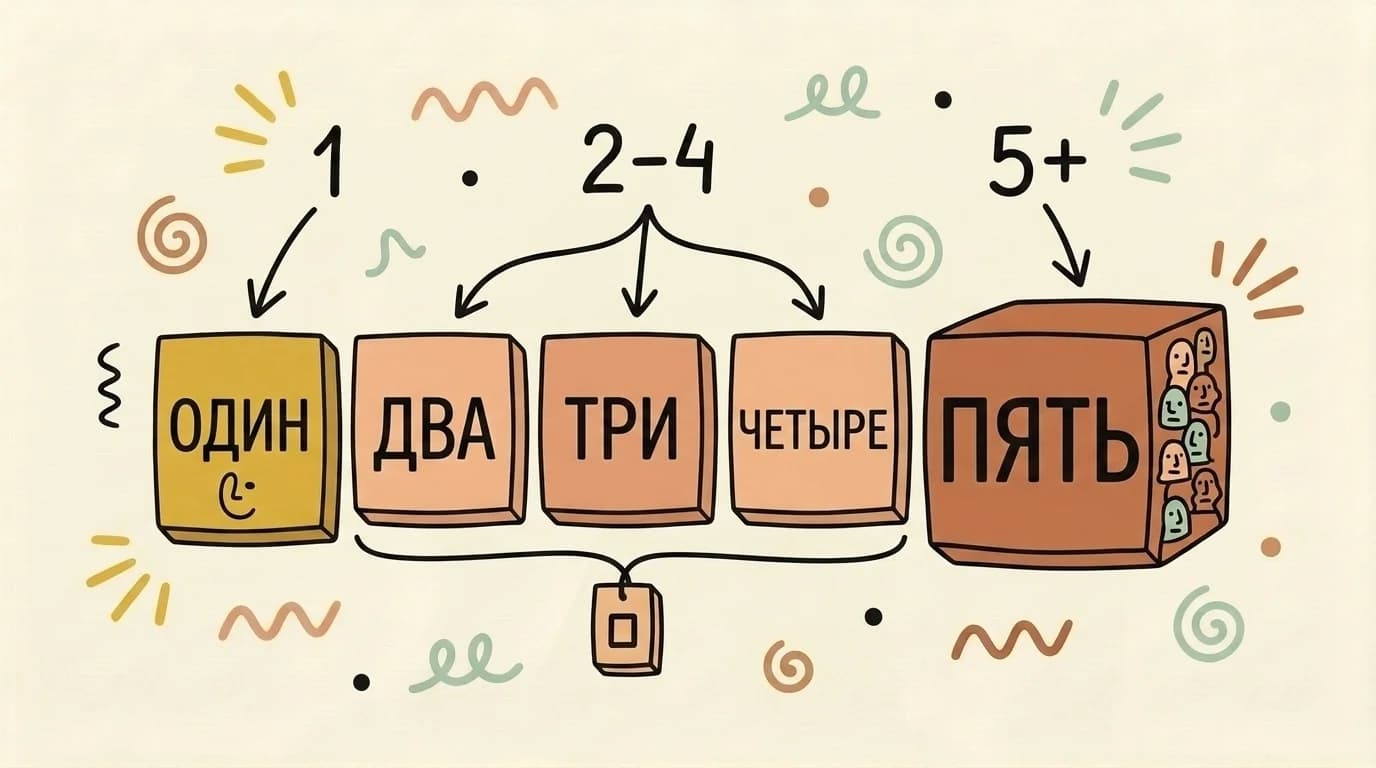
The rule is simple:
- 1 (and anything ending in 1, like 21, 31, 101) uses the nominative singular.
- 2, 3, 4 (and anything ending in 2, 3, 4, like 22, 33, 44) use the genitive singular.
- 5 through 20 (and anything ending in 5-9 or 0, like 25, 38, 100) use the genitive plural.
That’s it. Three cases. Three forms. You don’t need to conjugate the noun for every number. You just need to know which group the number belongs to.
Let’s see it with a word you already know: стол (stol, “table”).
- 1 стол (odin stol) — one table. Nominative singular.
- 2 стола (dva stola) — two tables. Genitive singular.
- 5 столов (pyat’ stolov) — five tables. Genitive plural.
Notice that “two tables” uses the singular form of the noun. That’s the part that trips people up. You’re saying “two of table,” basically. It’s not “tables” in the plural sense. It’s a different grammatical relationship.
Tip: Don’t think of it as “plural” in the English way. Think of it as “how many units.” 1 is one unit. 2-4 is a small group. 5+ is a big group. The noun just changes to match the group size.
The 1 group: easy street
Anything that ends in 1 uses the nominative singular. That’s the form you find in the dictionary. So if you know the word for “car” is машина (mashina), you already know how to say “one car” — одна машина (odna mashina). Same for 21, 31, 101. Just slap the number in front and you’re done.
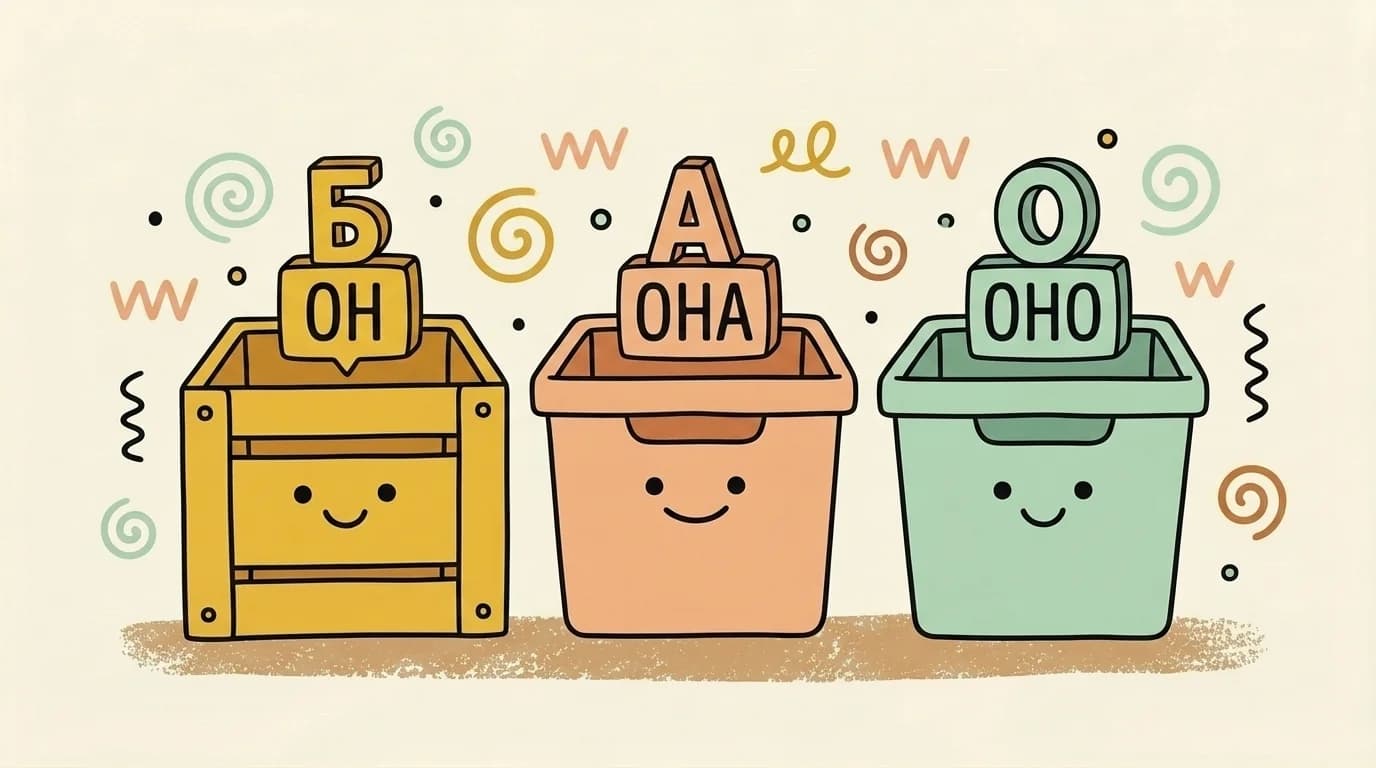
The only twist is that the number itself has to agree in gender. Один (odin) for masculine, одна (odna) for feminine, одно (odno) for neuter. But the noun stays put.
- Один студент (odin student) — one student (masculine).
- Одна книга (odna kniga) — one book (feminine).
- Одно окно (odno okno) — one window (neuter).
Easy. No surprises.
The 2-4 group: the sweet spot
This is where Russian gets playful. For numbers 2, 3, 4 (and any number ending in them), the noun goes into genitive singular. That means you take the nominative singular and change the ending.
For masculine nouns like стол (stol), genitive singular is стола (stola). So:
- 2 стола (dva stola)
- 3 стола (tri stola)
- 4 стола (chetyre stola)
For feminine nouns like книга (kniga), genitive singular is книги (knigi). So:
- 2 книги (dve knigi)
- 3 книги (tri knigi)
- 4 книги (chetyre knigi)
For neuter nouns like окно (okno), genitive singular is окна (okna). So:
- 2 окна (dva okna)
- 3 окна (tri okna)
- 4 окна (chetyre okna)
The pattern is consistent. The only hiccup is that the number itself changes form depending on gender. Два (dva) for masculine and neuter, две (dve) for feminine. Три (tri) and четыре (chetyre) don’t change.
Heads up: If the noun is animate (a person or animal), the accusative case for masculine nouns in this group behaves differently. But for now, stick with nominative and genitive. You’ll pick up the accusative shift naturally once you start making full sentences.
The 5+ group: the big crowd
Once you hit 5, the noun jumps to genitive plural. This is the form that looks most different from the singular. And it’s the one that makes learners groan. But there’s good news: genitive plural endings follow patterns you can learn in five minutes.
For masculine nouns, genitive plural often adds -ов (-ov) or -ей (-ey). For feminine nouns, the ending drops or changes to -ей (-ey). For neuter nouns, it often becomes nothing or -ей (-ey).
Examples:
- Стол (stol) → столов (stolov) — 5 столов (pyat’ stolov)
- Книга (kniga) → книг (knig) — 5 книг (pyat’ knig) (the -а drops)
- Окно (okno) → окон (okon) — 5 окон (pyat’ okon) (the -о becomes a fleeting vowel)
The key is to memorize the genitive plural for common words as you learn them. Don’t try to derive it from the singular every time. Just treat it like a separate piece of vocabulary.
- Друг (drug, “friend”) → друзей (druzey) — 5 друзей (pyat’ druzey)
- Сестра (sestra, “sister”) → сестёр (sestyor) — 5 сестёр (pyat’ sestyor)
- Место (mesto, “place”) → мест (mest) — 5 мест (pyat’ mest)
Notice that some words change their stem. That’s normal. Russian loves surprises.
Tip: When you learn a new noun, write down its genitive plural form right next to it. That way you never have to guess.
What about 0 and numbers like 21, 32, 44?
Great question. 0 uses the genitive plural, just like 5+. Ноль книг (nol’ knig) — zero books.
For numbers like 21, 32, 44, you look at the last digit. 21 ends in 1, so it uses the 1 group: двадцать одна книга (dvadtsat’ odna kniga). 32 ends in 2, so it uses the 2-4 group: тридцать две книги (tridtsat’ dve knigi). 44 ends in 4, so it uses the 2-4 group: сорок четыре книги (sorok chetyre knigi).
The only exception is numbers 11 through 14. They end in 1, 2, 3, 4, but they fall into the 5+ group. Why? Because Russian treats 11-20 as a block. So 11 книг (odinnadtsat’ knig), 12 книг (dvenadtsat’ knig), 13 книг (trinadtsat’ knig), 14 книг (chetyrnadtsat’ knig). Same for 111, 112, etc. The last two digits matter.
- 111 книг (sto odinnadtsat’ knig) — because 11 is in the 5+ group.
- 121 книга (sto dvadtsat’ odna kniga) — because 21 ends in 1.
This sounds tricky, but you’ll get used to it. Just remember: 11-14 are the rebels.
Real life examples from Russian culture
You’re in Moscow, at a киоск (kiosk), buying souvenirs. You see магниты (magnity, “magnets”). You want to say how many.
- Один магнит (odin magnit) — one magnet.
- Два магнита (dva magnita) — two magnets.
- Пять магнитов (pyat’ magnitov) — five magnets.
Or you’re at a bar with friends. You order:
- Одно пиво (odno pivo) — one beer.
- Два пива (dva piva) — two beers.
- Пять пив (pyat’ piv) — five beers.
Notice that пиво (pivo) is neuter. Genitive singular is пива (piva). Genitive plural is пив (piv). The ending drops.
Now imagine you’re talking about movies. Фильм (fil’m) is masculine.
- Один фильм (odin fil’m) — one film.
- Два фильма (dva fil’ma) — two films.
- Пять фильмов (pyat’ fil’mov) — five films.
You can use this pattern for anything. Books, friends, cats, ideas. Once you internalize it, you stop hesitating.
Why this matters for sounding natural
Native speakers don’t think about this rule. They just know that “two table” sounds wrong, and “five tables” sounds right. But the way they hear it is different from English. When you say два стола (dva stola), a Russian ear hears “two of table,” not “two tables.” It’s a subtle shift in perspective.
If you mess this up, you’ll still be understood. Saying “два стол” (dva stol) instead of “два стола” (dva stola) won’t cause a breakdown in communication. But it will mark you as a learner. And if you’re aiming for fluency, those small markers add up.
The good news is that this rule is one of the most consistent in Russian grammar. It doesn’t have exceptions for gender or animacy in the nominative case. It just works. Once you learn the genitive singular and genitive plural forms for your core vocabulary, you’re set.
Heads up: The genitive plural can have irregular forms, especially for common words. For example, человек (chelovek, “person”) has the genitive plural людей (lyudey). Деньги (den’gi, “money”) is already plural, so its genitive plural is денег (deneg). Learn these as exceptions. They’re few.
How to practice without drills
You don’t need to sit with a textbook and write out tables. Instead, use the rule in real contexts.
- Count things around you. Look at a bookshelf. Say how many books you see in Russian. “Одна книга, две книги, три книги, четыре книги, пять книг.” Do it out loud.
- Order food in your head. When you’re at a café, imagine ordering in Russian. “Один кофе, два кофе, три кофе, четыре кофе, пять кофе.” (Кофе is masculine and doesn’t change in singular or plural, but the number rule still applies. You’d say пять кофе with the noun in genitive plural, but since кофе is invariable, it stays the same. Easy.)
- Watch a Russian movie or show. Pause when characters mention quantities. Listen for the noun form. You’ll start noticing the pattern.
If you want to go deeper, work with a native speaker. That’s where real progress happens. In my 1-on-1 online lessons, we spend ten minutes on this rule, then we use it in conversation for the rest of the hour. No drills. Just real talk about what you did yesterday, what you’re planning, how many things you saw. It sticks faster because it’s connected to your life.
Try this today
You don’t need to wait. Here’s a short exercise to lock in the rule.
-
Take three nouns you know: one masculine (like дом, dom, “house”), one feminine (like сумка, sumka, “bag”), one neuter (like яблоко, yabloko, “apple”). Write their genitive singular and genitive plural forms. (Check a dictionary if you’re unsure.)
-
Say the numbers 1 through 10 with each noun. Out loud. “Один дом, два дома, три дома, четыре дома, пять домов, шесть домов…” Do it for all three nouns.
-
Pick a number between 21 and 100. Say it with each noun. “Тридцать одна сумка, тридцать две сумки, тридцать три сумки, тридцать четыре сумки, тридцать пять сумок.” Notice how the last digit decides the form.
-
Describe your kitchen in Russian. “У меня одна плита, две чашки, три тарелки, четыре вилки, пять ложек.” (Pli ta, chashki, tarelki, vilki, lozhek.) Don’t worry about perfect pronunciation. Just get the forms right.
-
Text a Russian-speaking friend or write in a journal: “Сегодня я выпил(а) два кофе и съел(а) три яблока.” (Segodnya ya vypil(a) dva kofe i s”yel(a) tri yabloka.) “Today I drank two coffees and ate three apples.” It’s a small sentence, but it uses the rule in action.
You’ll mess up. That’s fine. The point is to train your ear and your tongue. After a week of this, the 1, 2-4, 5+ rule will feel like second nature. And when you’re at a bar in Moscow and you order пять пив (pyat’ piv) without thinking, you’ll realize you’ve crossed a threshold. That’s the moment it clicks.