You have a noun. You need to say “my book” or “big table” or “that window.” In English, you just say it. In Russian, the word itself decides what happens to everything around it. You learn “книга (kniga, book)” and then someone tells you it’s feminine. And you think: “Why does a book have a gender? It’s a book. It doesn’t have a gender.” I get it. I felt the same way when I started learning Polish, which has the same system. But here is the thing: gender in Russian is not about the thing itself. It is about the word. It is a grammatical rule, not a philosophical statement. And once you see the pattern, it takes about five minutes to learn the basics. Then you spend the rest of your life practicing, but the basics are that fast.
Which format grows your game fastest?
The three colors of Russian nouns
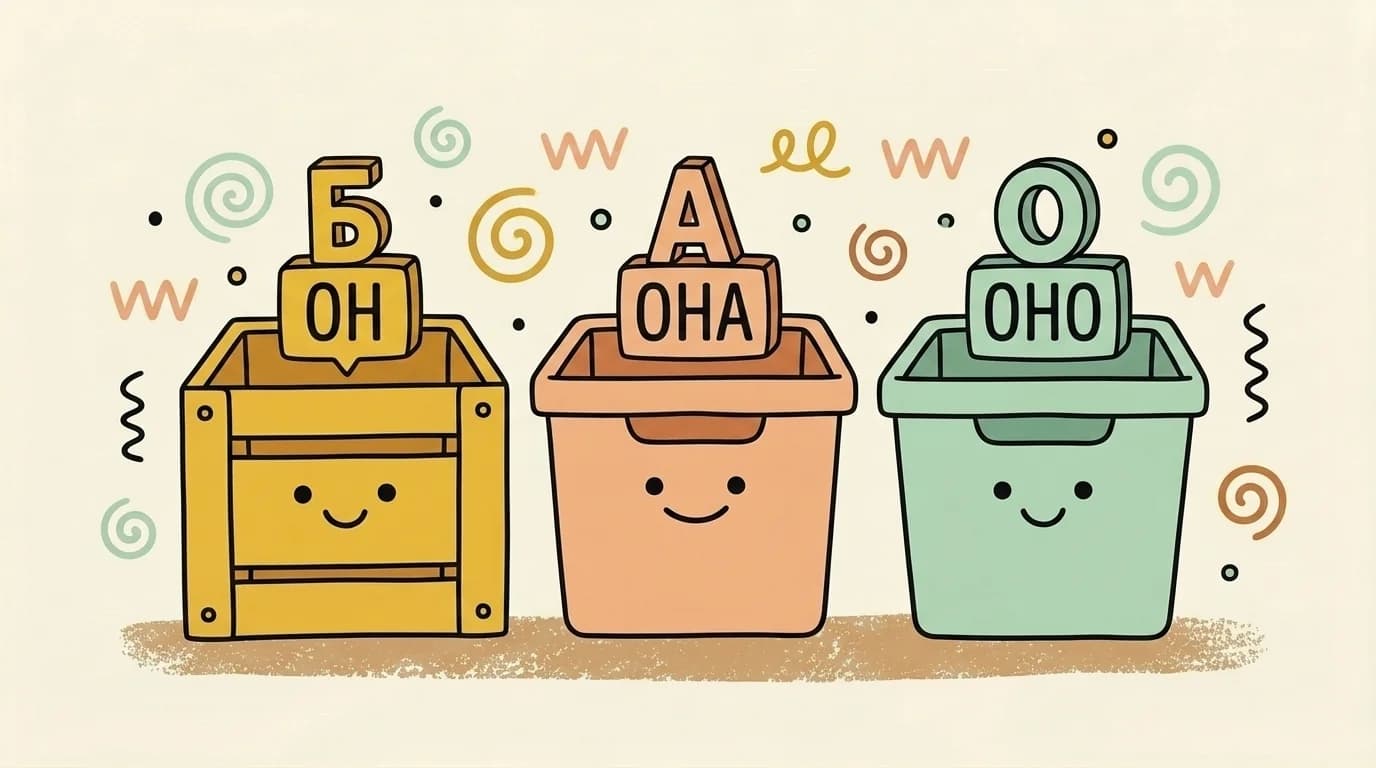
Russian nouns come in three genders: masculine, feminine, and neuter. You do not need to memorize a list. You need to look at the ending of the word. That is the whole trick. If you see a noun in its dictionary form (nominative case, singular), the last letter tells you the gender.
Masculine nouns usually end in a consonant. Think of words like стол (stol, table), дом (dom, house), and день (den', day). They are solid, they end with a hard or soft consonant sound. If the word ends in -й (like музей, muzey, museum) or -ь (like словарь, slovar', dictionary), it is also masculine. The -ь is a soft sign, and it can be masculine or feminine, so you need to learn those individually, but most common -ь words are feminine. More on that in a second.
Feminine nouns usually end in -а or -я. Examples: книга (kniga, book), вода (voda, water), семья (sem'ya, family). Also, words ending in -ь can be feminine, like ночь (noch', night) and мышь (mysh', mouse). The pattern is: if it ends in -а or -я, it is feminine. If it ends in -ь, check the dictionary or remember the common ones.
Neuter nouns usually end in -о or -е. Examples: окно (okno, window), море (more, sea), and время (vremya, time) which is a little irregular but still neuter. Also, words ending in -мя (like имя, imya, name) are neuter. They are a small group. You will learn them as you go.
Tip: When you learn a new noun, learn it with its gender. Say “стол, он (stol, on, he/ it masculine)” or “книга, она (kniga, ona, she/ it feminine).” This builds the habit. Your brain will start to feel the pattern after a few weeks.
Why gender actually matters (and not just for grammar tests)
If you only ever use nouns in isolation, gender does not matter. But the moment you want to say “this big red book,” gender kicks in. Adjectives change their endings to match the noun. Possessives like “my” or “your” change. Past tense verbs change. Even numbers change in some cases.
Take the word “my” in Russian: мой (moy) for masculine nouns, моя (moya) for feminine, моё (moyo) for neuter. So “my book” is моя книга (moya kniga). “My table” is мой стол (moy stol). “My window” is моё окно (moyo okno). If you say “мой книга,” a Russian speaker will understand you, but they will wince internally. The same goes for adjectives: “big table” is большой стол (bol'shoy stol), “big book” is большая книга (bol'shaya kniga), “big window” is большое окно (bol'shoye okno).
This is not extra work. This is the system. Once you accept that every noun has a gender and that you have to match the words around it, you stop fighting it and start using it. It becomes a rhythm. Masculine words feel hard, feminine words feel soft, neuter words feel neutral. You will start to guess correctly even for words you have never seen, because the ending is that reliable.
The two tricky groups: -ь and loanwords
Every rule has exceptions. Russian is no different. The two main trouble spots are words ending in -ь and foreign words that entered Russian recently.
Words ending in -ь can be either masculine or feminine. You have to learn them individually. But here is a shortcut: most -ь words that describe abstract concepts, actions, or natural phenomena are feminine. For example, жизнь (zhizn', life), смерть (smert', death), любовь (lyubov', love), ночь (noch', night), мысль (mysl', thought). Words that describe people, professions, or concrete objects are often masculine, like учитель (uchitel', teacher), день (den', day), конь (kon', horse), словарь (slovar', dictionary). This is not 100 percent, but it is a good guess.
Heads up: The word путь (put', path or way) is masculine. The word мать (mat', mother) is feminine. They both end in -ь. You just have to remember these. Write them down. Say them out loud. They are common.
Loanwords from English and other languages usually keep the gender of the original word or take on the gender of the Russian category they fall into. For example, кофе (kofe, coffee) is masculine even though it ends in -е, because it used to be “кофий” in older Russian. But in casual speech, some people treat it as neuter. The official rule is masculine. Similarly, метро (metro, subway) is neuter, because it ends in -о. Пальто (pal'to, coat) is neuter. Виски (viski, whiskey) is neuter. ТВ (TV, television) is masculine because the word телевизор (televizor) is masculine. You will pick these up by hearing them in context.
How to practice without flashcards (because flashcards are boring)
You do not need to sit down and drill a list of 100 nouns with their genders. That works for some people, but it is dry. Instead, use the language you already interact with.
Pick a song you like in Russian. Look up the lyrics. Find the nouns. Write down three of them and note their gender. For example, in the song “Мой мармеладный” (Moy marmeladny, My Marmalade) by Katya Lel, the word “мармелад” (marmelad, marmalade) is masculine. The word “любовь” (lyubov', love) is feminine. The word “сердце” (serdtse, heart) is neuter. You just learned three genders from one song.
Watch a short scene from a Russian movie or a YouTube vlog. Pause when you hear a noun. Write it down. Guess the gender. Check online or with a native speaker. You will be right 80 percent of the time after a week of this.
Read a simple Russian text, like a news headline or a menu. Menus are great because they have lots of nouns. “Суп” (sup, soup) is masculine. “Пицца” (pizza, pizza) is feminine. “Мороженое” (morozhenoye, ice cream) is neuter. You are learning gender while deciding what to order.
The one time gender disappears (and why it is confusing)
In the plural, gender stops mattering for adjectives and possessives. “My books” is мои книги (moi knigi), “my tables” is мои столы (moi stoly), “my windows” is мои окна (moi okna). The word “мои” is the same for all genders. Adjectives also become the same: “big books” is большие книги (bol'shiye knigi), “big tables” is большие столы (bol'shiye stoly), “big windows” is большие окна (bol'shiye okna). This is a relief. But it also means you cannot rely on plural forms to guess the gender of the singular. You have to know the singular form.
Some learners find this frustrating because they learn a noun in the plural first (like “деньги, den'gi, money,” which is plural and has no singular) and then have no idea what gender it is. Money is technically feminine in the singular (деньга, den'ga, an old form), but nobody uses it. So you just learn деньги as a plural-only word. There are a few of those. You will encounter them naturally.
Why you should stop worrying and love the system
Gender is not a test of your intelligence. It is a feature of the language, like tones in Chinese or cases in Finnish. English speakers are not used to it, so it feels arbitrary. But it is not arbitrary. It is consistent. Once you learn the endings, you can predict the gender of most new words. And when you get it wrong, nobody will laugh at you. They will correct you and move on.
I have taught students who spent months avoiding adjectives because they were scared of gender agreement. That is a waste of time. You can make mistakes. The goal is communication, not perfection. If you say “мой книга,” a Russian speaker will know you mean “my book.” They might think you are a beginner, but they will understand. Then you say “моя книга” next time. That is how you learn.
Tip: When you meet a new noun, say it out loud with the word “этот” (etot, this) for masculine, “эта” (eta, this) for feminine, “это” (eto, this) for neuter. “Этот стол” (etot stol, this table). “Эта книга” (eta kniga, this book). “Это окно” (eto okno, this window). This trains your ear and your mouth at the same time.
Try this today
You do not need a textbook. You need five minutes and a few objects around you.
-
Look around the room you are in. Pick three objects. Write them down in Russian. If you do not know the word, look it up. Then guess the gender based on the ending. Check your guesses with a dictionary or a native speaker.
-
Take a sentence you use often, like “This is my phone.” Translate it into Russian: “Это мой телефон” (Eto moy telefon). Now change the object to “book” (книга, kniga). The sentence becomes “Это моя книга” (Eto moya kniga). Now change it to “window” (окно, okno). “Это моё окно” (Eto moyo okno). Say all three out loud.
-
Find a Russian song on YouTube. Write down the first noun you hear. Write its gender. Do this for three different songs.
-
If you have a Russian-speaking friend or a tutor, send them a voice message saying “Это мой ____” and fill in the blank with a noun. Ask them to correct your gender if you got it wrong. If you do not have a tutor, you can find one online. I teach 1-on-1 online lessons, and we do exactly this kind of thing in the first session. It is faster than you think.
-
Tomorrow morning, when you wake up, say out loud the gender of three objects in your bedroom. “Стол — masculine. Кровать — feminine. Окно — neuter.” That is it. You just practiced Russian gender before breakfast.