You have been studying Russian for three months. You can read the alphabet, you know that "спасибо" (spasibo, "thank you") is not a swear word, and you have even managed to say "Я из Лондона" (ya iz Londona, "I am from London") without your tongue tying itself into a knot. But last night, you tried to watch a Russian movie with subtitles, and by the time you decoded the first sentence, the scene had changed three times. You closed the laptop and opened a bag of chips instead. I see you.
How do you actually train chess?
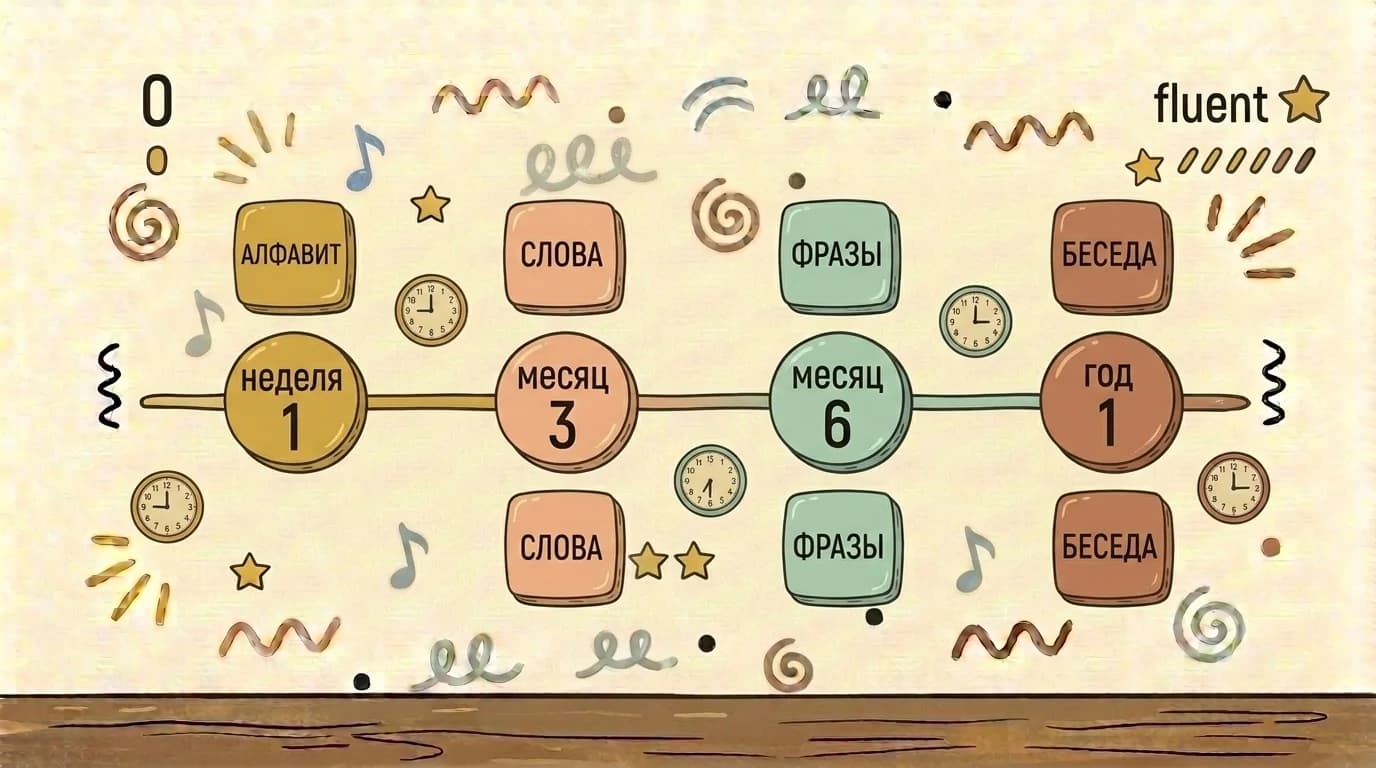
The internet is full of promises. "Fluent in 3 months." "Speak Russian like a native in 30 days." Let me be honest with you, as a friend and a teacher: those timelines are garbage. Not because you are lazy, but because Russian is a different beast. It has cases, a flexible word order, and a relationship with verbs that borders on obsessive. But here is the good news: you do not need to be fluent to have a real conversation. You need to be functional, confident, and comfortable with being wrong. That is the realistic goal. And it takes between 6 and 12 months of consistent, smart practice.
Let me break down what that timeline actually looks like, and why you should stop measuring your progress by how many words you know and start measuring it by how many sentences you can survive.
The first 3 months: building the survival kit
The first three months are not about fluency. They are about not dying of embarrassment when someone asks you a basic question. This phase is deceptively simple and deceptively hard.
Start with the alphabet. Yes, the Cyrillic script. It takes a normal person about a week to recognize the letters and another week to stop reading every word like a robot. Do not skip this. Transcribing Russian into Latin letters is a crutch that will break your ankle later. Learn to read "где туалет?" (gde tualet, "where is the bathroom?") in Cyrillic, and you will never have to panic in a Moscow café.
Next, focus on the 100 most common words. Not nouns like "refrigerator" or "bureaucracy." Words like "я" (ya, "I"), "ты" (ty, "you" informal), "да" (da, "yes"), "нет" (net, "no"), "хорошо" (khorosho, "good/okay"), and "почему" (pochemu, "why"). These are the bricks. You also need a handful of verbs in the present tense: "говорить" (govorit, "to speak"), "делать" (delat, "to do"), "идти" (itti, "to go"), "знать" (znat, "to know"). Learn them as chunks, not conjugations. For example, learn "я говорю" (ya govoryu, "I speak") as a single unit, like a Lego piece. You can rearrange Legos later.
Tip: Do not learn "I am" separately. In Russian, you do not say "I am Alex." You say "Я Алекс" (Ya Aleks). That is it. No verb. If you try to insert "to be" in the present tense, you will sound like a robot from a 1980s sci-fi movie. Save yourself the awkwardness.
By the end of month three, your goal is to be able to have a 30-second conversation that sounds like this:
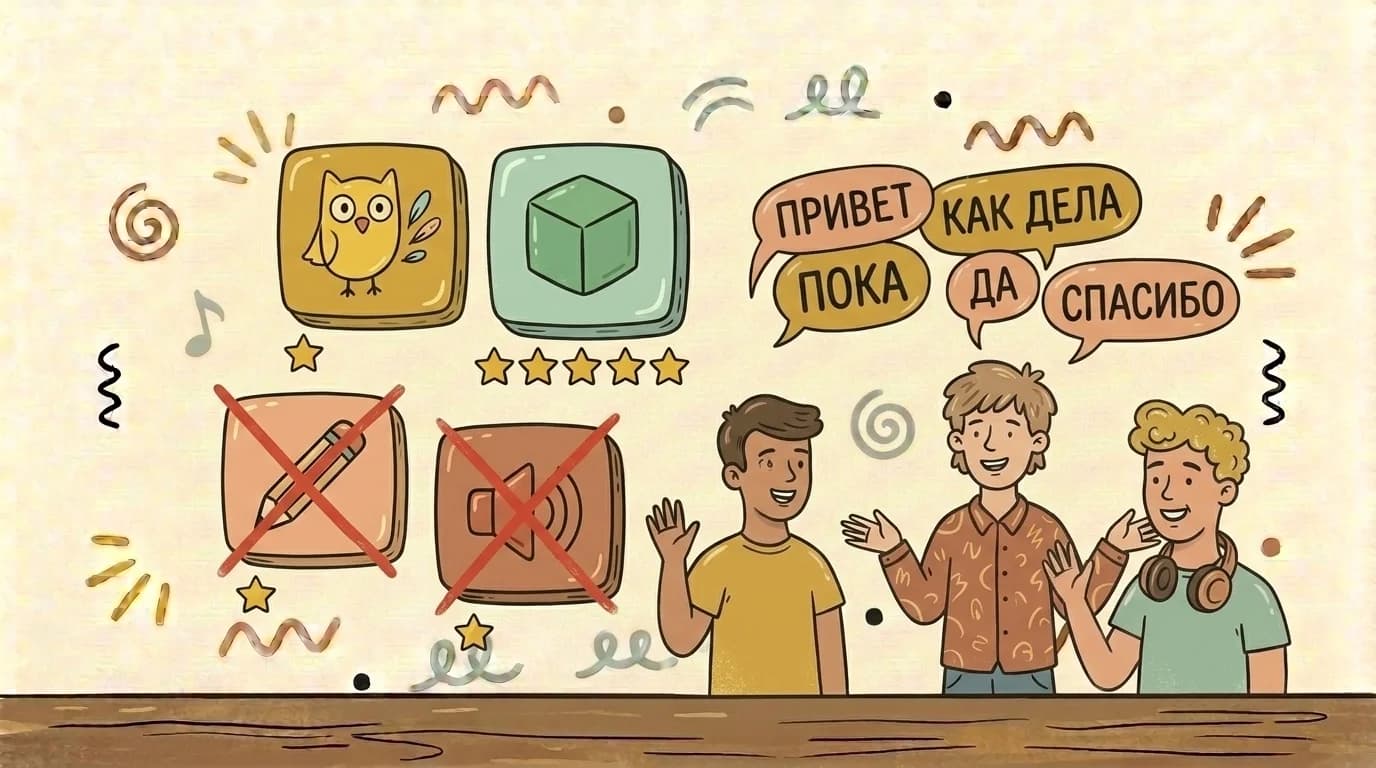
- "Привет, как дела?" (Privet, kak dela? "Hi, how are you?")
- "Хорошо, спасибо. А у тебя?" (Khorosho, spasibo. A u tebya? "Good, thanks. And you?")
- "Тоже хорошо. Ты откуда?" (Tozhe khorosho. Ty otkuda? "Also good. Where are you from?")
- "Я из Лондона." (Ya iz Londona. "I am from London.")
That is it. That is the entire conversation. But if you can say it without pausing to think, you have already won. Most learners never get past this point because they try to learn too many words too fast. You do not need to know the word for "screwdriver" or "parliament" yet. You need to survive a 30-second chat.
The middle phase: months 4 to 6 and the case of the missing endings
This is where most people quit. Around month four, you will realize that Russian nouns change their endings depending on what they are doing in the sentence. This is called "cases." There are six of them. They are not your enemy, but they are not your friend either.
Let me give you an example. The word for "book" is "книга" (kniga). But if you say "I see a book," it becomes "книгу" (knigu). If you say "I am reading a book," it is still "книгу." If you say "without a book," it becomes "без книги" (bez knigi). If you say "I am talking about a book," it is "о книге" (o knige). This looks insane. I know.
Here is the secret: you do not need to master all six cases in month four. You need to master two: the nominative (the dictionary form) and the accusative (the "I see X" form). That covers 80 percent of what you will say in a casual conversation. The other four cases you will pick up naturally by hearing them repeated. Your brain is a pattern-finding machine. Trust it.
Focus on phrases that force you to use the accusative. For example, "Я люблю тебя" (Ya lyublyu tebya, "I love you") is accusative. "Я вижу кошку" (Ya vizhu koshku, "I see a cat") is accusative. Learn these as set phrases. Do not try to decline every noun you meet. That is a recipe for a headache and a glass of vodka.
Heads up: In this phase, you will feel like you are regressing. You will forget words you knew last week. You will confuse "мой" (moy, "my" masculine) and "моя" (moya, "my" feminine). This is normal. Your brain is restructuring itself. Think of it like renovating a kitchen. For a few weeks, everything is dusty and you cannot find the spoons. Then suddenly, it works.
By month six, you should be able to handle a 2-minute conversation. You can talk about where you live, what you do for work (even if you only know the verb "работать" (rabotat, "to work") and the word for "office"), and what you like or do not like. You can order food in a restaurant without pointing at the menu. You can ask for directions and maybe understand the answer if the person speaks slowly and uses their hands.
The breakthrough: months 7 to 9 and the art of sounding human
Around month seven, something shifts. You stop translating in your head. You hear "как пройти к вокзалу?" (kak proyti k vokzalu, "how to get to the train station?") and you understand it as a whole unit, not as five separate words. This is the moment you have been waiting for.
Now you can start playing with the language. You can add filler words like "ну" (nu, "well/so") and "вот" (vot, "here/there") to sound more natural. You can use "типа" (tipa, "like/as if") the way English speakers use "like" in casual speech. You can say "Я, типа, не знаю" (Ya, tipa, ne znayu, "I, like, don't know") and feel like a local.
This is also the time to tackle verbs of motion. Russian has a special relationship with moving around. There is "идти" (itti, "to go on foot one direction") and "ходить" (khodit, "to go on foot regularly/back and forth"). There is "ехать" (ekhat, "to go by vehicle one direction") and "ездить" (yezdit, "to go by vehicle regularly"). It is annoying, but it is also beautiful. Once you get it, you will never confuse "I am walking to the store" with "I walk to the store every Tuesday."
By month nine, you can watch a Russian film with Russian subtitles and understand maybe 40 percent of the dialogue. You will miss jokes, cultural references, and half the plot. But you will catch the emotional tone. You will laugh when the character says something sarcastic, even if you do not catch every word. That is real progress.
The long game: months 10 to 12 and the confidence to be wrong
The final stretch is not about learning more grammar. It is about learning to be okay with being wrong. You will say "я пошёл в магазин" (ya poshyol v magazin, "I went to the store") when you meant "I will go to the store." A native speaker will correct you, or they will not, and you will both move on. That is fine.
At this point, you can have a 10-minute conversation with a patient native speaker. You can talk about your weekend, your job, your favorite music, and your opinion on whether borscht is better hot or cold (it is better hot, by the way, and anyone who says otherwise is a spy). You can make mistakes with cases and still be understood. You can ask for clarification: "Повтори, пожалуйста, медленнее" (Povtori, pozhaluysta, medlennee, "Repeat, please, slower").
This is also the point where you realize that Russian culture and language are inseparable. You cannot speak Russian well without understanding why "авось" (avos, "maybe/perhaps/hope-so") is a whole worldview. You cannot order tea without knowing that "чай" (chay) is always offered with sugar and a story. The language opens the door to a way of thinking that is less direct, more patient, and deeply human.
Try this today
You do not need to wait until next month to start. Here is a 5-minute exercise you can do right now, wherever you are. It is designed to move you from "I know words" to "I can use words."
-
The 10-second test. Stand up. Look around the room. Name every object you see in Russian. If you do not know the word, describe it. "Эта штука для питья" (Eta shtuka dlya pitya, "This thing for drinking") is better than silence. Do this for 10 seconds. Do not stop.
-
The mirror monologue. Look at yourself in the mirror. Say out loud: "Меня зовут [your name]. Я из [your city]. Я учу русский язык, потому что [your reason]." (Menya zovut [name]. Ya iz [city]. Ya uchu russkiy yazyk, potomu chto [reason]. "My name is [name]. I am from [city]. I am learning Russian because [reason].") If you do not know the word for your reason, say it in English and laugh. That counts.
-
The question game. Write down three questions you would ask a new friend in English. Translate them into Russian using only words you already know. If you cannot translate them exactly, simplify them. "What is your favorite movie?" becomes "Ты любишь кино?" (Ty lyubish kino? "Do you like cinema?"). Good enough.
-
The 30-second story. Tell a true story about your day in Russian. It can be as boring as "I drank coffee and fed my cat." The goal is not to impress anyone. The goal is to speak without stopping. "Я пил кофе и кормил кота" (Ya pil kofe i kormil kota). If you mess up the verb endings, great. You are learning.
-
The native moment. Find a 15-second clip of a Russian song or a scene from a Russian TV show. Listen to it three times. Try to repeat exactly what you hear, even if you do not understand it. Focus on the rhythm, the intonation, the way the sounds slide into each other. You are not learning words here. You are learning how to sound like a human instead of a textbook.
If you want to go deeper, I teach 1-on-1 online lessons where we skip the drills and talk about real things. We argue about whether "The Idiot" by Dostoevsky is actually a comedy (it is). We practice ordering coffee in Russian until the barista in your head stops laughing. And we do it at your pace, not the pace of a curriculum written by someone who has never tried to learn a second language.
Six months from now, you will not be fluent. But you will be able to walk into a Russian grocery store, ask for a specific kind of cheese, and walk out with cheese instead of a block of butter. That is a win. Celebrate it.