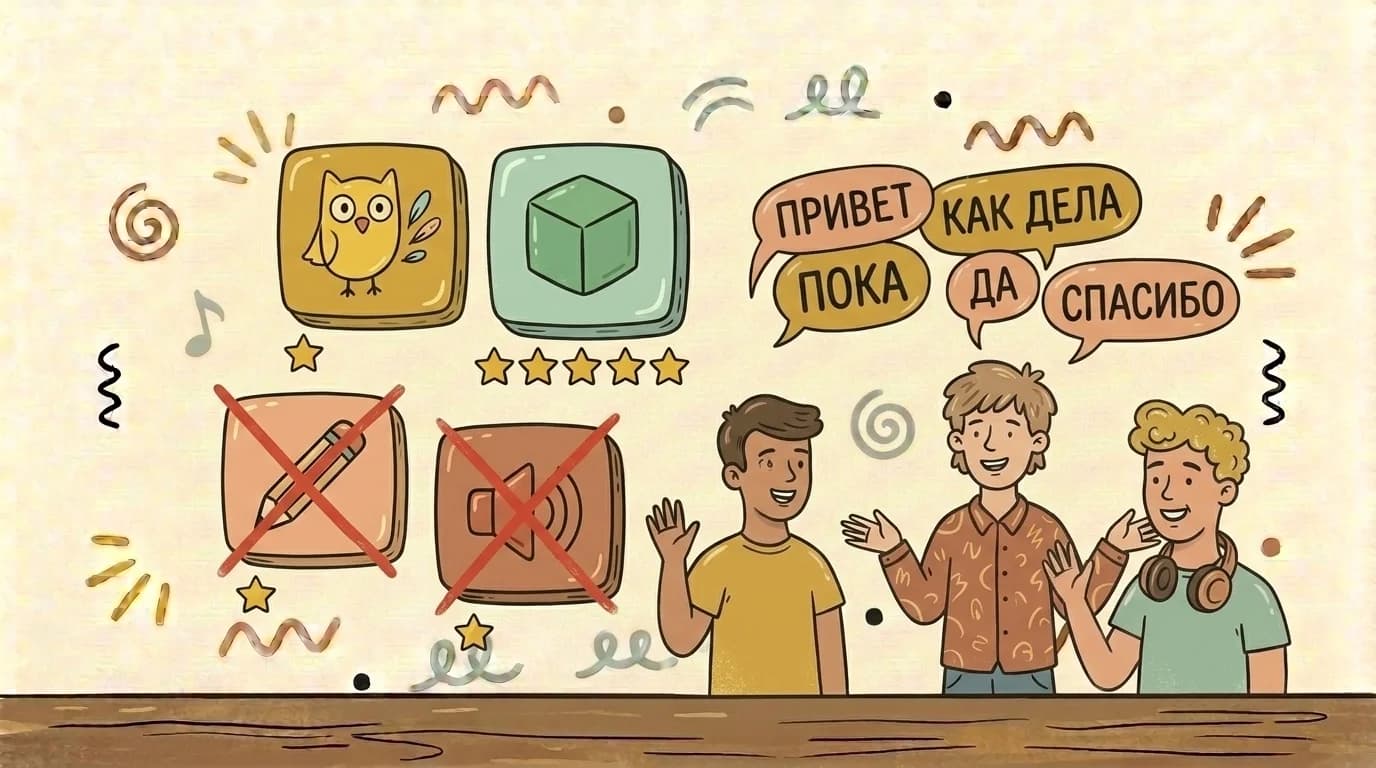
You have a full time job, a social life, and maybe even a cat that demands attention every time you open a textbook. You want to learn Russian, but moving to Moscow or St. Petersburg is not in your near future.
How do you actually train chess?
Good news. You do not need a plane ticket to start speaking real Russian. You just need to stop treating the language like a museum exhibit and start treating it like a tool you use every day. Here is how to practice Russian without leaving your couch, your city, or your comfort zone.
Stop waiting for fluency. Start making mistakes.
The biggest lie language apps sell you is that you need to be "ready" before you speak. You do not. You need to be willing to sound like a confused toddler for a while. That is the price of entry.
If you wait until your grammar is perfect, you will never speak. Native Russian speakers do not care if you mix up cases. They care if you try. I have had students who could barely form a sentence but won over a babushka at a local market just by saying "извините, я учусь" (izvinite, ya uchus', "excuse me, I'm learning") with a smile.
So start making mistakes now. Say "я хочу кофе" (ya khochu kofe, "I want coffee") even if you are not sure about the genitive case. Say "как дела?" (kak dela?, "how are things?") to your reflection. The goal is not perfection. The goal is momentum.
Tip: Record yourself saying one sentence every day. Do not listen back for a week. Then listen. You will hear progress that you did not notice in the moment.
Use the internet like a Russian teenager
You do not need to be in Russia to hear Russian every day. You need to change where you hang out online. Stop watching "learn Russian" videos that sound like a robot reading a script. Go where real Russians actually talk.
Start with YouTube. Search for влог (vlog, "vlog") or обзор (obzor, "review") on a topic you already love. Cooking, gaming, makeup, tech. If you like video games, search for летсплей (letspley, "let's play") and watch someone play your favorite game in Russian. You will hear natural speech, slang, and frustration. That is real language.
Move to Telegram channels. Russians love Telegram. Find a channel about your hobby. Read the comments. Russians comment a lot. You will see short, fast, emotional Russian. That is how people actually talk.
And do not forget music. Russian pop, rap, and indie music are full of phrases you will actually use. Listen to someone like Монеточка (Monetochka) or Скриптонит (Skryptonite). Look up the lyrics. Sing along. Your pronunciation will improve without you noticing.
Heads up: Do not try to understand every word. Aim for 50 percent comprehension. Your brain will fill in the rest over time. This is how children learn.
Change your phone and your habits
This is the cheapest and most effective trick. Change your phone language to Russian. Yes, it will be uncomfortable for three days. Then your brain will adapt. You will learn words like настройки (nastroyki, "settings"), уведомления (uvedomleniya, "notifications"), and контакты (kontakty, "contacts") without studying them.
Do the same with your social media. Follow Russian accounts on Instagram, TikTok, or Twitter. Do not just follow language teachers. Follow comedians, chefs, photographers, and news accounts. The algorithm will start feeding you Russian content. You will absorb phrases without effort.
And here is a habit that works: write your grocery list in Russian. Seriously. Write молоко (moloko, "milk"), хлеб (khleb, "bread"), яйца (yaytsa, "eggs"). It takes ten seconds. It forces your brain to connect the word to a real object, not a flashcard.
Talk to yourself like a crazy person
I know it sounds strange. It works. Talking to yourself in Russian is one of the best ways to practice when you have no one else to talk to.
Describe what you are doing. "Я сейчас варю кофе" (ya seychas varyu kofe, "I am making coffee right now"). "Я иду в магазин" (ya idu v magazin, "I am going to the store"). "Мне нужно позвонить маме" (mne nuzhno pozvonit' mame, "I need to call mom").
If you get stuck on a word, look it up immediately. Do not wait. The moment you realize you do not know the word for "refrigerator" is the moment you will remember it forever. Look it up. Say it out loud. Use it in a sentence.
This technique works because it removes the pressure of performing for someone else. You can make mistakes. You can repeat yourself. You can sound ridiculous. No one is judging you.
Tip: If you feel silly, do it in the shower. The acoustics are great, and no one can hear you.
Find a language partner who is not a robot
Apps like HelloTalk and Tandem exist for a reason. But you need to use them strategically. Do not just send "привет, как дела?" and wait. That is boring for everyone.
Instead, send a voice message. Ask a real question. "Что ты думаешь о новом фильме?" (Chto ty dumayesh' o novom fil'me?, "What do you think about the new movie?"). Share a photo of your lunch and ask "Что это?" (Chto eto?, "What is this?"). Make it a conversation, not an interview.
You can also offer something in return. Many Russian speakers want to practice English. You can trade. Thirty minutes of Russian, thirty minutes of English. This is fair and productive.
But be careful. Some people on these apps just want to date. Set clear boundaries. Say "я только учусь" (ya tol'ko uchus', "I am only learning") early. Most people will respect that.
Watch Russian TV and movies with a twist
You have heard this advice before. Watch movies with subtitles. But here is the twist. Do not use English subtitles. Use Russian subtitles. And do not try to understand everything.

Pick a movie or show you already know. "Брат" (Brat, "Brother") is a classic. "Кухня" (Kukhnya, "Kitchen") is a fun sitcom. "Любовь и голуби" (Lyubov' i golubi, "Love and Doves") is a Soviet comedy that still makes people laugh.
Watch the first time with Russian subtitles. Pause when you hear a word you recognize. Write it down. Watch the same scene again. Then move on. Do not rewind ten times. Your brain needs repetition over time, not in one sitting.
If you want to level up, watch a news channel like RT or Дождь (Dozhd', "Rain") for five minutes a day. News anchors speak clearly. You will hear the same words every day: президент (prezident, "president"), экономика (ekonomika, "economy"), погода (pogoda, "weather"). Repetition is your friend.
Read things that are not textbooks
Textbooks are fine for grammar rules. They are terrible for real language. Read things that Russians actually read.
Start with Instagram captions. They are short, emotional, and full of slang. Read the comments. You will see phrases like "кек" (kek, "lol") and "зашквар" (zashkvar, "cringe") and "имба" (imba, "OP" or "overpowered").
Move to news headlines. Read the title of one article on Lenta.ru or Meduza. Do not read the whole article. Just the headline. You will learn vocabulary about politics, sports, and scandals. That is more useful than knowing the word for "pencil case" (пенал, penal).
If you want a challenge, find a recipe in Russian. Recipes use imperative verbs and measurements. "Добавьте соль" (Dobav'te sol', "Add salt"). "Нарежьте лук" (Narezh'te luk, "Chop the onion"). You can cook dinner and learn grammar at the same time.
Make Russian a part of your routine, not a chore
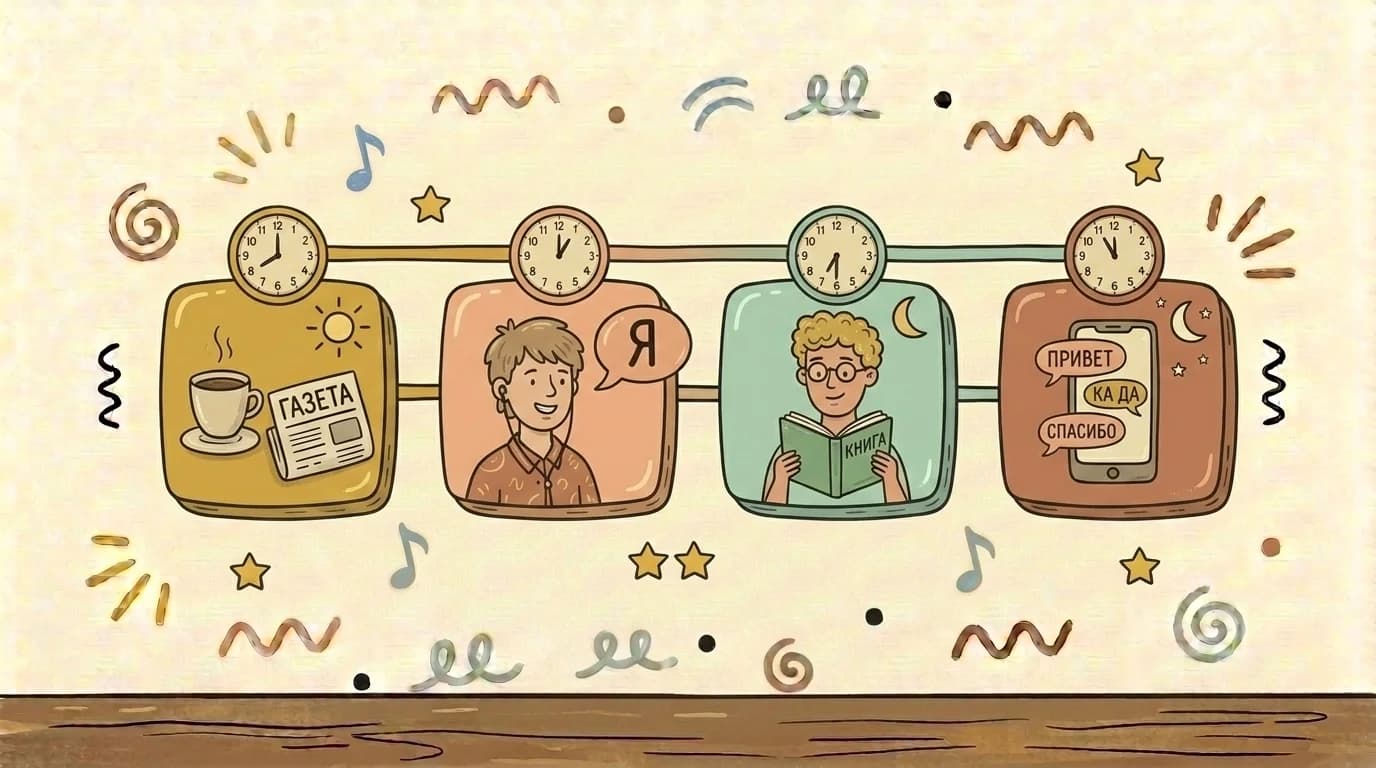
The secret to practicing without living in Russia is consistency, not intensity. Five minutes every day is better than two hours once a week.
Pick one habit. Just one. Change your phone language. Write your grocery list in Russian. Listen to one Russian song on your commute. Describe your morning routine out loud. That is enough.
When you make Russian a small, daily part of your life, it stops feeling like homework. It becomes background noise. And background noise is how you learn a language without realizing it.
If you want more structure and a real conversation partner, I teach 1-on-1 online lessons. We skip the drills and talk about what you actually care about. Music, travel, food, your life. No textbooks, no pressure. Just real Russian for real people.
Try this today
Here are five mini-tasks. Do them in any order. Do them in five minutes total.
- Change your phone language to Russian. Do it now. Keep it for one week.
- Write your grocery list in Russian. Include at least five items.
- Find one Russian song you like. Listen to it twice. Read the lyrics once.
- Describe what you are wearing out loud in Russian. "Я в джинсах и футболке" (Ya v dzhinsakh i futbolke, "I am wearing jeans and a t-shirt").
- Send one voice message in Russian to a language partner or to yourself. Say what you ate for breakfast.
That is it. You do not need to live in Russia. You just need to start.