You've been studying Russian for months. You know the alphabet, you can read signs, you even survived a few awkward conversations with your friend's Russian grandmother. But when you try to say "I usually have coffee and a sandwich for breakfast," your brain freezes. You reach for the verb "to have" (иметь, imet') and realize that's for possession, not eating. You give up and say "I drink coffee and eat sandwich" like a caveman.
How do you actually train chess?
It's not your vocabulary that's failing you. It's the gap between knowing words and using them in real, messy life. The solution isn't more flashcards. It's building tiny, repeatable habits that force Russian into your daily routine, not as a subject, but as a reflex.
Here's how to make Russian stick without turning your life into a classroom.
The 5 minute rule: morning micro-routines
Your brain is most plastic in the first hour after waking. That's when you can hack your language learning without extra effort. But if you sit down with a textbook, you're already fighting your own resistance. Instead, try a 5 minute mental warm-up that requires zero materials.
Start with the first thing you see when you open your eyes. Your phone, your ceiling, your partner's face. Name it in Russian. Then add a verb. Then add a time.
Я вижу потолок (ya vizhu potolok, "I see the ceiling"). Я встаю в семь (ya vstayu v sem', "I get up at seven"). Я иду в ванную (ya idu v vannuyu, "I go to the bathroom").
Do this for exactly 5 minutes. No more. Your brain will protest at minute 4, but that's the point. You're training it to switch into Russian mode before the day's chaos begins.
Tip: Keep a sticky note on your bathroom mirror with 3 verbs you want to master that week. Change them every Monday. This works better than any app notification because you can't swipe it away.
Shower conversations: your private speaking club
The shower is the only place where you can talk to yourself without judgment. Use it. Pick one situation you're likely to face that day and narrate it in Russian. A meeting, a phone call, a trip to the store. You don't need to be perfect. You need to be fluent enough to keep the story going.
Here's a sample script for a coffee shop visit:
Я захожу в кофейню (ya zakhozhu v kofeynyu, "I enter the coffee shop"). Я говорю: "Здравствуйте, можно латте?" (ya govoryu: "Zdravstvuyte, mozhno latte?" "I say: Hello, can I have a latte?"). Бариста отвечает: "Вам с собой?" (barista otvechaet: "Vam s soboy?" "The barista answers: For here or to go?").
Say it out loud. Then repeat it faster. Then change the order. This is not memorization. This is muscle memory for your mouth. The hot water and steam help you relax your throat, which is crucial for producing the Russian 'r' and soft consonants without tension.
Heads up: If you feel silly, you're doing it right. The embarrassment means you're pushing past the comfort zone where real learning happens. Also, your shower voice is always better than your classroom voice. Trust me.
Grocery grammar: label your world
You don't need a textbook to learn cases. You need a fridge. Go to your kitchen and pick 5 items. Write their names in Russian on sticky notes and attach them. But don't stop at nouns. Add a prepositional phrase for each.
Молоко в холодильнике (moloko v kholodil'nike, "milk in the fridge"). Хлеб на столе (khleb na stole, "bread on the table"). Яблоко в вазе (yabloko v vaze, "apple in the bowl").
Every time you open the fridge, you're drilling the prepositional case without a single grammar chart. When you grab the milk, say "Я беру молоко" (ya beru moloko, "I take the milk") to practice the accusative. When you put it back, say "Молоко стоит в холодильнике" (moloko stoit v kholodil'nike, "The milk stands in the fridge") for the prepositional again.
This works because your brain loves spatial memory. You're anchoring grammar to physical locations. In a week, you'll know the prepositional case for 20 common nouns without ever opening a grammar book.
The commute loop: music and shadowing
Whether you drive, walk, or take the subway, your commute is a dead zone. Fill it with Russian audio that matches your level. Not podcasts about Russian history. Not Tolstoy audiobooks. Music and short dialogues you can shadow.
Shadowing means you repeat what you hear, trying to match the speaker's rhythm and intonation. It's not translation. It's parrot mode. Start with a song you like. Find the lyrics on Genius. Listen to one line, pause, repeat it. Then the next line. Then the whole verse.
Try this with a track from Zemfira or Kino. Their pronunciation is clear, and the vocabulary is everyday Russian. For example, from Kino's "Группа крови" (gruppa krovi, "blood type"):
Моё сердце бьётся (moyo serdtse b'yotsya, "my heart beats").
Repeat it 5 times. Then try it at the same speed as the singer. You'll notice your tongue does things it never did before. That's because you're mimicking a native speaker's mouth movements, not your textbook's artificial slowness.
Tip: Use the app Anki or a simple voice memo to record yourself. Listen back. You'll cringe. That's gold. The cringe shows you exactly where your pronunciation breaks down.
Dinner table storytelling: the 3 sentence rule
You sit down to eat. You're tired. The last thing you want is a grammar drill. So don't drill. Tell a story about your day in exactly 3 sentences. No more. No less.

Сегодня я работал до шести (segodnya ya rabotal do shesti, "Today I worked until six"). Потом я пошёл в магазин (potom ya poshël v magazin, "Then I went to the store"). Я купил курицу и рис (ya kupil kuritsu i ris, "I bought chicken and rice").
This is your daily victory lap. You're using past tense, prepositions, and basic vocabulary in a coherent narrative. If you can't make 3 sentences, you've found your gap. Maybe you don't know the past tense of "to go" (идти, idti). Good. Now you know what to review tomorrow.
Don't write these sentences down. Say them out loud. To your cat. To your plant. To the wall. The act of speaking forces your brain to retrieve the words from memory, which strengthens the neural pathways. Writing is passive. Speaking is active.
The evening review: one mistake, one fix
Before bed, think about one mistake you made that day. Not all of them. One. Pick the one that annoyed you most. Then figure out the correct version.
Maybe you said "Я хочу купить хлеб" (ya khochu kupit' khleb, "I want to buy bread") but you forgot that "хлеб" (khleb, "bread") is masculine and needed the accusative form "хлеб" (khleb, no change). Wait, that's correct. But maybe you said "Я хочу купить молоко" (ya khochu kupit' moloko, "I want to buy milk") and that's also correct because neuter nouns don't change in the accusative. So your mistake was something else.
The point isn't to fix everything. It's to build the habit of noticing. When you start noticing your own errors, you become your own teacher. That's the only kind of teaching that lasts.
Heads up: Don't do this for more than 2 minutes. If you start analyzing every mistake, you'll burn out. One mistake per day, 365 days a year, is 365 fixed errors. That's a new language in a year.
Why this works (and textbooks don't)
Textbooks teach you Russian as a system. They give you the blueprint for a house you've never seen. But you don't need a blueprint. You need to walk through the rooms, touch the walls, and stub your toe on the furniture.
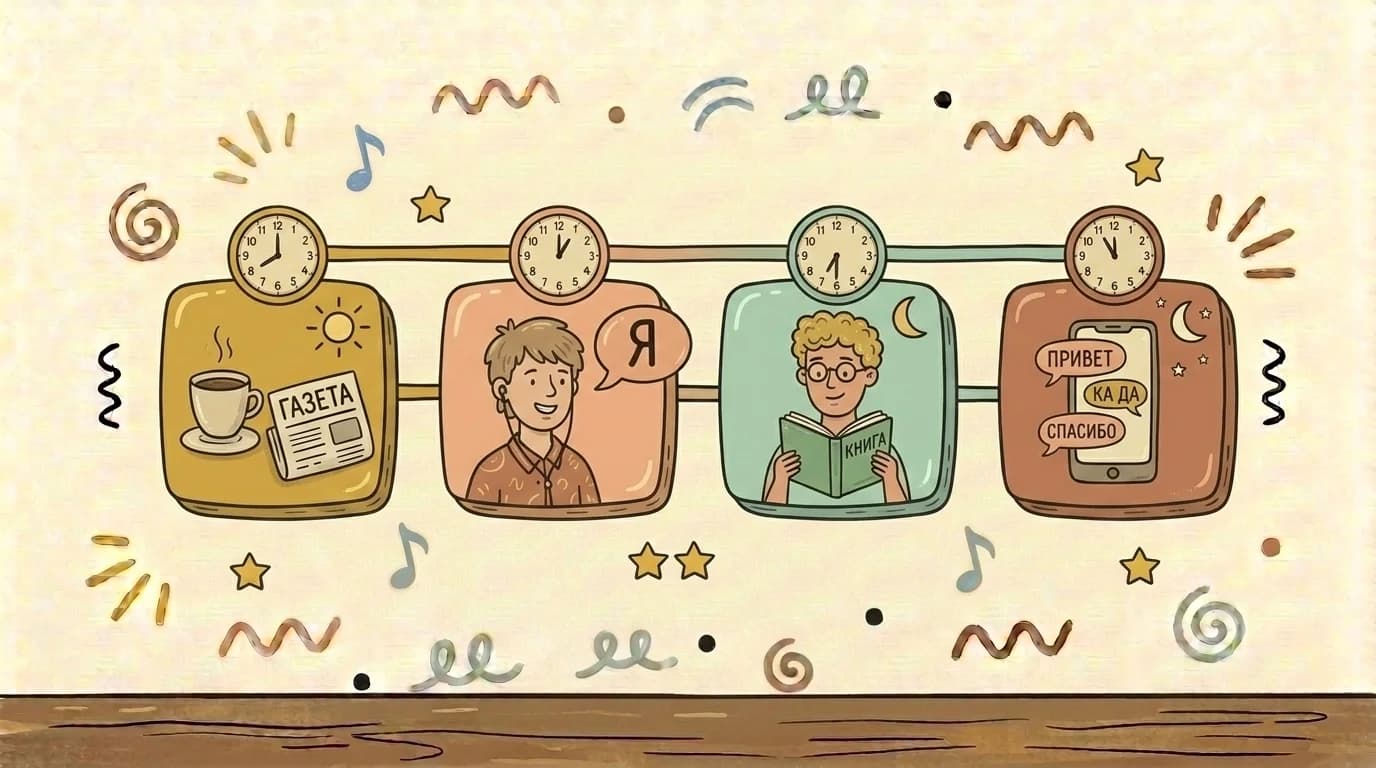
These routines work because they embed language into your existing life. You're not adding a 30 minute study session to your already full schedule. You're piggybacking on habits you already have: waking up, showering, eating, commuting, sleeping.
The grammar sticks because it's tied to real actions. The vocabulary sticks because you see it, touch it, and say it every day. The pronunciation sticks because you're using your mouth in a natural context, not repeating "здравствуйте" (zdravstvuyte, "hello") into a microphone 50 times.
And when you're ready to go deeper, you can take these same routines into 1-on-1 online lessons where a native speaker can catch the mistakes you don't notice and push you into conversations that feel real, not scripted.
Try this today
Pick one routine from this list and do it right now. Don't wait for Monday. Don't wait for the "perfect time." Do it now.
-
Wake up: Look at your phone. Say "Это мой телефон" (eto moy telefon, "this is my phone"). Then look at the window. Say "Это окно" (eto okno, "this is a window"). Do it 3 times.
-
Shower: Narrate your morning routine in Russian. Start with "Я просыпаюсь" (ya prosypayus', "I wake up"). End with "Я готов" (ya gotov, "I'm ready"). You don't need to be perfect. Just speak.
-
Kitchen: Put a sticky note on your coffee maker that says "кофе" (kofe, "coffee"). Every time you make coffee, say "Я делаю кофе" (ya delayu kofe, "I make coffee").
-
Commute: Pick one Russian song you like. Find the lyrics. Shadow the first verse. Do it 3 times. You'll sound weird. That's the point.
-
Dinner: Tell yourself 3 sentences about your day in Russian. Out loud. If you can't, say "Я не знаю" (ya ne znayu, "I don't know") and try again tomorrow.
Do these 5 things for one week. Then come back and tell me what changed. I bet you'll be surprised.