You have learned the alphabet. You can read street signs. You can even order a beer without pointing at the menu. But then a friendly Russian asks you something simple, like "How are you?" and your brain freezes. You know the words, but you are not sure which one to use, or what to say back without sounding like a robot from a 1980s textbook.
What kind of player are you really?
This is the gap between knowing grammar and having a conversation. Small talk in Russian is not just about vocabulary. It is about rhythm, tone, and knowing which phrase actually gets used by real people, not by the characters in your coursebook. Let me give you the ten phrases you will use first, and more importantly, how to use them without panic.
The greeting that actually works
You probably learned здравствуйте (zdravstvuyte, "hello") as the standard formal greeting. It is correct. It is polite. But in everyday life, especially with friends, colleagues you know well, or people your age, you will hear something shorter.
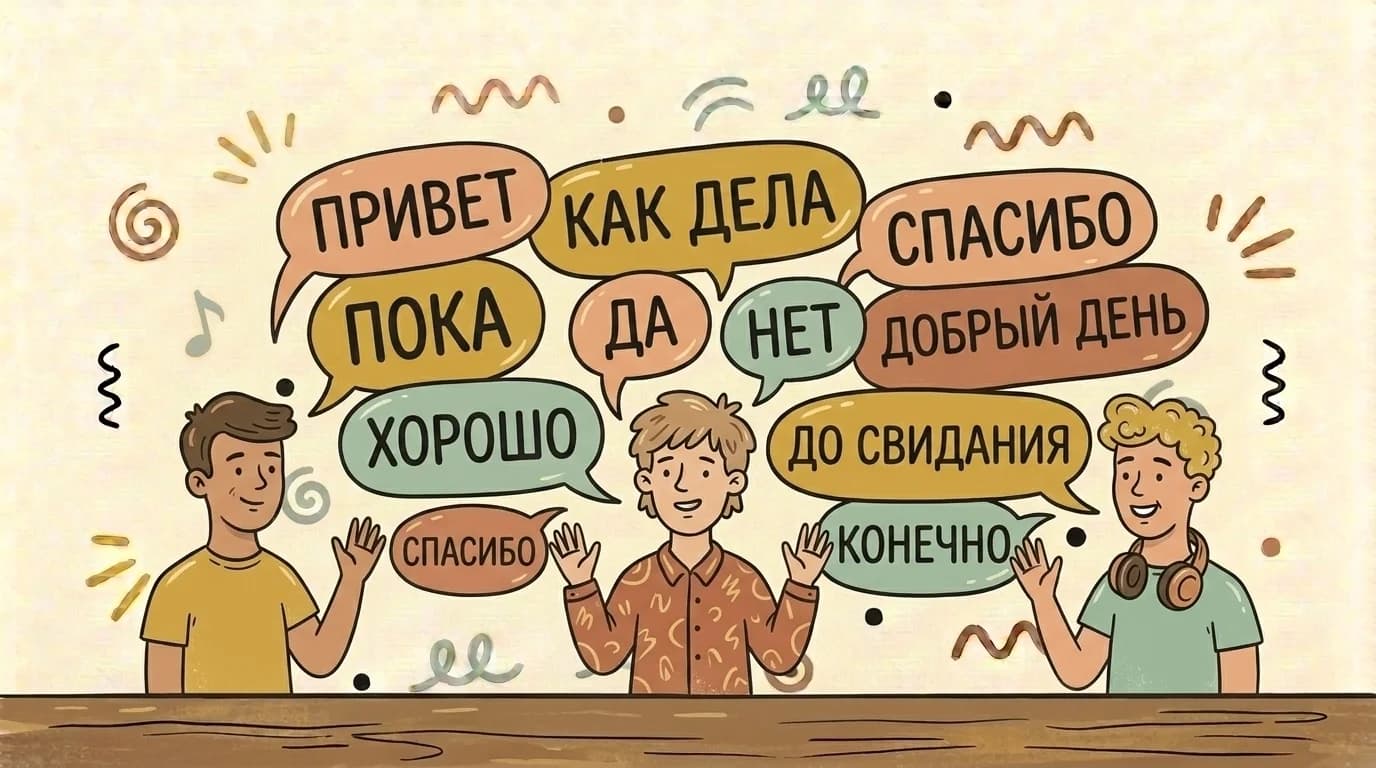
Привет (privet, "hi") is your go-to for informal situations. It is simple, fast, and friendly. If you want to be a little more casual, you can say приветик (privetik, "hi there"), which is like a soft, affectionate version. Do not overthink it. If you are talking to someone older or in a professional setting, stick with здравствуйте. But if you are at a party, a cafe, or chatting online, привет is your friend.
Heads up: Do not use здравствуйте with your close friends. It sounds like you are mocking them or you have just met them for the first time. Russians will notice and might ask if you are feeling okay.
How are you? The real version
The textbook version is как дела? (kak dela?, "how are things?"). It is fine, but it is also the most generic question in the language. You will hear it constantly. But there are better, more natural ways to ask.
Как ты? (kak ty?, "how are you?") is more personal and direct. Use it with people you know. Как жизнь? (kak zhizn?, "how's life?") is another common one. It sounds a bit more open, like you are genuinely interested in what is going on.
And here is a secret. When someone asks you как дела?, you do not have to give a real answer. The standard reply is нормально (normal'no, "fine") or всё хорошо (vsyo khorosho, "everything is good"). If you are feeling great, say отлично (otlichno, "great"). If things are bad, you can say так себе (tak sebe, "so-so") or не очень (ne ochen', "not great"). But do not dump your life story on someone who just asked out of politeness. Keep it short.
What is your name? (And how to remember it)
Как тебя зовут? (kak tebya zovut?, "what's your name?") is the standard question. The answer is меня зовут... (menya zovut..., "my name is..."). Easy.
But the tricky part is that Russians often use the full name plus patronymic in formal settings. So if you meet someone older or in a business context, they might introduce themselves as Анна Петровна (Anna Petrovna) or Иван Сергеевич (Ivan Sergeyevich). Do not panic. Just say очень приятно (ochen' priyatno, "nice to meet you") and try to remember the name. If you forget, it is okay to ask again politely. Извините, как вас зовут? (izvinite, kak vas zovut?, "sorry, what's your name?") works fine.
Tip: When you introduce yourself, say your name clearly. Russians might struggle with unfamiliar sounds, so slow down a little. If your name is hard to pronounce, you can offer a short version. I have taught students named "John" who became Джон (Dzhon) and it works just fine.
Where are you from? (A conversation starter)
Откуда ты? (otkuda ty?, "where are you from?") is a natural follow-up after names. If you are from another country, this is your moment. Russians love talking about travel and other cultures.
Your answer: Я из... (ya iz..., "I am from..."). For example, Я из Лондона (ya iz Londona, "I am from London") or Я из США (ya iz SShA, "I am from the USA").
After you say where you are from, expect a follow-up question. Далеко? (daleko?, "far away?") or Как тебе Москва? (kak tebe Moskva?, "how do you like Moscow?"). Have a simple answer ready. Мне нравится (mne nravitsya, "I like it") is enough. Or очень красиво (ochen' krasivo, "very beautiful").
Do you speak Russian? (The honest question)
Ты говоришь по-русски? (ty govorish' po-russki?, "do you speak Russian?") is a question you will hear often. The answer depends on your level. If you are a beginner, say немного (nemnogo, "a little"). If you are intermediate, say немного, но учусь (nemnogo, no uchus', "a little, but I am learning").
Russians will usually be impressed that you are trying. They might switch to English to help you, but do not take it as an insult. They are just being polite. If you want to keep practicing in Russian, say давай по-русски, пожалуйста (davay po-russki, pozhaluysta, "let's speak Russian, please").
Heads up: If you say я не говорю по-русски (ya ne govoryu po-russki, "I don't speak Russian"), people will immediately switch to English or stop talking. So only use that if you really want to end the conversation.
The magic word: Thank you
Спасибо (spasibo, "thank you") is the most important word in any language. In Russian, you can also say большое спасибо (bol'shoye spasibo, "thank you very much") or спасибо большое (spasibo bol'shoye, same thing, just reversed order).
For a more casual thank you, especially among friends, use спасибки (spasibki, "thanks"). It is like the English "thanks a bunch." Do not use it with strangers or older people. It sounds too familiar.
And when someone thanks you, reply with пожалуйста (pozhaluysta, "you're welcome"). Or не за что (ne za chto, "don't mention it"). The second one is more casual and friendly.
Yes, no, and maybe
Да (da, "yes") and нет (net, "no") are simple. But in Russian small talk, you will also hear ага (aga, "uh-huh") and неа (nea, "nope"). These are very informal. Use them with friends, not in a job interview.
Может быть (mozhet byt', "maybe") is useful when you are not sure. Наверное (navernoye, "probably") is also common. For example, ты придёшь? (ty pridyosh'?, "will you come?"), answer наверное (navernoye, "probably").
The weather small talk (Yes, it matters)
Russians talk about the weather a lot, especially in winter. Холодно (kholodno, "it is cold") and жарко (zharko, "it is hot") are the basics. Сегодня холодно (segodnya kholodno, "today it is cold") is a full sentence.
You can also say какая погода? (kakaya pogoda?, "what is the weather like?"). The answer might be солнечно (solnechno, "sunny"), дождливо (dozhdlivo, "rainy"), or ветрено (vetreno, "windy").
Tip: If you want to sound like a local, complain about the weather. Опять дождь (opyat' dozhd', "rain again") or сколько можно? (skol'ko mozhno?, "how much longer?") are classic Russian grumbles.
Goodbye (and how to leave gracefully)
Пока (poka, "bye") is the informal goodbye. До свидания (do svidaniya, "goodbye") is formal. You can also say увидимся (uvidimsya, "see you") or до встречи (do vstrechi, "until we meet").
If you are leaving a party or a gathering, say мне пора (mne pora, "I have to go") or я пошёл/пошла (ya poshol/poshla, "I am off"). The ending changes based on your gender. Men say пошёл, women say пошла.
The response you will use most: "Really?"
In any conversation, you will need to show you are listening. Правда? (pravda?, "really?") is the simplest. Да ну? (da nu?, "no way?") is more surprised. Серьёзно? (ser'yozno?, "seriously?") works too.
These little words keep the conversation flowing. They show you are engaged, even if your grammar is not perfect.
Try this today
Pick three of these phrases and use them in real life today. You do not need a partner. You can practice in your head, out loud, or with a language app.
- Say
привет(privet) to yourself five times, with a smile. Get used to the sound. - Answer the question
как дела?withнормально(normal'no) andотлично(otlichno). Say them both out loud. - Introduce yourself in Russian.
Меня зовут...(menya zovut...) and addочень приятно(ochen' priyatno). - Ask the weather question.
Какая погода?(kakaya pogoda?) and answer withсолнечно(solnechno) orхолодно(kholodno). - End a fake conversation with
пока(poka) andувидимся(uvidimsya).
If you want to practice these phrases in a real conversation, I teach 1-on-1 online lessons where we skip the drills and talk like actual humans. You will be surprised how fast you improve when you stop worrying about perfect grammar and start using the language.