You know that feeling when you walk into a café, your stomach growling, and you freeze because the menu is all in Cyrillic and the barista is waiting? You end up pointing at something random, hoping it’s not a beet smoothie. It’s happened to the best of us.
How do you actually train chess?
The good news is that ordering food in Russian doesn't require a textbook or a perfect accent. It requires a few key phrases, a bit of cultural know-how, and the willingness to sound a little silly at first. Whether you're in a bustling Moscow coffee shop or a formal restaurant in St. Petersburg, the words you use can change the entire experience. Let’s break it down.
The big difference: cafe vs restaurant
In Russian, the line between a кафе (kafe, "cafe") and a ресторан (restoran, "restaurant") is more than just menu prices. A кафе is usually casual, often self-service or with minimal table service. You order at the counter, pay, then sit down. A ресторан is full service. A waiter comes to your table, you order from a menu, and you pay after eating.
This matters because the language you use changes. In a cafe, you can be direct and fast. In a restaurant, you need more polite forms and a bit of patience.
Heads up: In many Russian cities, especially smaller ones, a "cafe" can also be a place that serves full meals like soup, salad, and a main dish. Don't expect just pastries. And in a restaurant, it's normal to wait a few minutes before the waiter approaches. No one is ignoring you, it's just the rhythm.
The magic phrase for cafes: "Мне, пожалуйста"
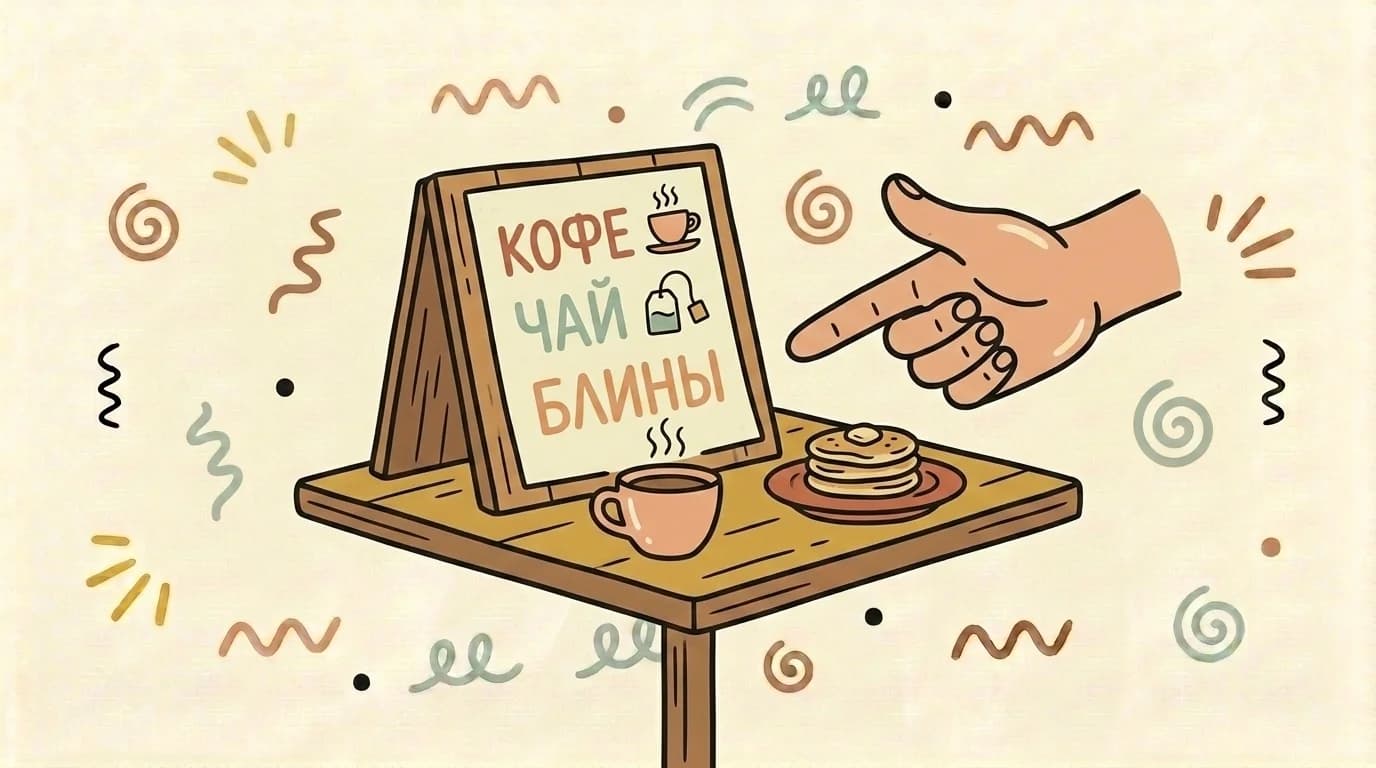
If you learn one phrase for cafes, make it this one: Мне, пожалуйста (mne, pozhaluysta). It means "For me, please" and it's your all-purpose ordering tool.
You say it while pointing at the menu or the display case. The barista will then ask what you want. You can reply with just the name of the item, or point and say это (eto, "this one"). For example:
- Мне, пожалуйста, латте (mne, pozhaluysta, latte).
- Мне, пожалуйста, вот это (mne, pozhaluysta, vot eto, "this one here").
No need to say "I want" or "I would like." In a cafe, it's all about brevity. The staff expects short, clear orders.
Tip: If you want to say "and" between items, use и (ee). For example: Мне, пожалуйста, латте и круассан (mne, pozhaluysta, latte i kruassan).
Restaurant ordering: the polite approach
In a restaurant, you need a few more steps. You'll be seated, given a menu, and then a waiter will come. The first thing they say is often Здравствуйте (zdravstvuyte, "hello") or Добрый день (dobryy den, "good afternoon"). You reply the same.
When you're ready to order, you can say:
- Я буду заказывать (ya budu zakazyvat, "I will order") or more commonly, just start with your request.
The polite way to order is to use the phrase Я бы хотел/хотела (ya by khotel/khotela, "I would like"). Men say хотел, women say хотела. For example:
- Я бы хотела борщ (ya by khotela borshch, "I would like borscht").
- Я бы хотел стейк с картошкой (ya by khotel steyk s kartoshkoy, "I would like a steak with potatoes").
You can also use Можно (mozhno, "may I have") which is very common. Можно мне меню? (mozhno mne menyu, "May I have the menu?"). Or Можно мне счёт? (mozhno mne schyot, "May I have the bill?").
Heads up: In restaurants, it's normal to say Спасибо (spasibo, "thank you") after the waiter takes your order. And when they bring the food, another Спасибо is expected. It's not overkill, it's polite.
What to say when you don't understand the menu
Menus in Russia can be overwhelming. Even if you know the words, the descriptions might be long and full of unfamiliar ingredients. Here's what you can do.
First, ask the waiter: Что вы посоветуете? (shto vy posovetuyete, "What do you recommend?"). This is a great conversation starter and shows you're engaged. Waiters often love giving recommendations.
If you see a word you don't know, point and say: А это что? (a eto shto, "And what is this?"). Or more politely: Подскажите, пожалуйста, что это? (podskazhite, pozhaluysta, shto eto, "Tell me please, what is this?").
For example, you might see кролик в сметане (krolik v smetane, "rabbit in sour cream"). If you're not sure, ask. Waiters are used to tourists.
Tip: If you're vegetarian or have allergies, learn the key words. Мясо (myaso, "meat"), рыба (ryba, "fish"), овощи (ovoshchi, "vegetables"), орехи (orekhi, "nuts"), молоко (moloko, "milk"). You can say: У меня аллергия на орехи (u menya allergiya na orekhi, "I have an allergy to nuts"). Or: Я не ем мясо (ya ne em myaso, "I don't eat meat"). This is straightforward and waiters will take it seriously.
Drinks and desserts: the little extras
In cafes, drinks are the main event. Coffee culture in Russia is strong, especially in cities. You'll see options like:
- Американо (amerikano, "Americano")
- Капучино (kapuchino, "cappuccino")
- Латте (latte)
- Чай (chay, "tea") – often black tea with sugar and lemon
If you want your coffee to go, say: С собой (s soboy, "to go"). For example: Мне, пожалуйста, латте с собой (mne, pozhaluysta, latte s soboy).
In restaurants, drinks are usually ordered separately. You might be asked: Что будете пить? (shto budete pit, "What will you drink?"). You can say: Воду, пожалуйста (vodu, pozhaluysta, "water please"). Or: Мне сок (mne sok, "juice for me").
For dessert, the word is десерт (desert). You can ask: Какие у вас десерты? (kakiye u vas deserty, "What desserts do you have?"). Or point at a display case: Мне вот этот пирожок (mne vot etot pirozhok, "I'll have this pastry").
Paying and leaving
In cafes, you usually pay at the counter before you sit down. In restaurants, you pay after the meal. When you're ready to leave, catch the waiter's eye and say: Можно счёт? (mozhno schyot, "May I have the bill?"). Or more formally: Принесите, пожалуйста, счёт (prinesite, pozhaluysta, schyot, "Bring the bill please").
Tipping is not mandatory but is appreciated. In cafes, rounding up or leaving 10-50 rubles is fine. In restaurants, 10% is standard. You can say: Сдачи не надо (sdachi ne nado, "Keep the change").
Heads up: In some restaurants, especially more expensive ones, the bill might already include a service charge (обслуживание, obsluzhivaniye). Check before you tip extra.
Real talk: what not to say
Avoid using Ты (ty, informal "you") with waitstaff or baristas. Always use Вы (vy, formal "you") unless you're in a very casual place and the staff is your age. It's a simple rule that makes a big difference.
Also, don't say Дай (day, "give me") unless you're talking to a close friend. Use Дайте (dayte, polite "give me") or Принесите (prinesite, "bring me"). For example: Дайте, пожалуйста, меню (dayte, pozhaluysta, menyu, "Give me the menu please").
And one more thing. If you're in a restaurant and the waiter brings you bread or a small appetizer without you asking, it's usually free. But check. If you eat it, you might be charged. When in doubt, ask: Это бесплатно? (eto besplatno, "Is this free?").
Try this today
You don't need a trip to Russia to practice. You can simulate ordering right now. Here are five mini-tasks to try today.
-
Order a coffee. Say out loud: Мне, пожалуйста, капучино (mne, pozhaluysta, kapuchino). Repeat it five times until it feels natural.
-
Ask for a recommendation. Say: Что вы посоветуете? (shto vy posovetuyete). Imagine you're in a restaurant and the waiter is waiting. Say it with a smile.
-
Order two items. Say: Мне, пожалуйста, борщ и хлеб (mne, pozhaluysta, borshch i khleb, "borscht and bread"). Practice the и (ee) sound.
-
Ask for the bill. Say: Можно счёт, пожалуйста? (mozhno schyot, pozhaluysta). Pretend you're finishing a meal. Say it clearly.
-
Leave a tip. Say: Сдачи не надо (sdachi ne nado). Imagine you're handing over cash. Feel the confidence.
If you want to practice these phrases in a real conversation with a native speaker, that's where 1-on-1 online lessons come in. We can roleplay a cafe or restaurant scenario, and I'll give you instant feedback on your pronunciation and word choice. No drills, just real talk.
Now go order something. Even if it's just a imaginary latte in your kitchen. You've got this.