You know that awkward pause mid-sentence when you’re trying to sound fluent, but your brain just grabs for “and” or “but” again. You’ve memorized hundreds of words, yet your Russian still comes out like a string of Lego blocks — functional, but clunky.
What kind of player are you really?
The secret isn’t more vocabulary. It’s the glue. Connectors — those tiny words and phrases that link your thoughts, show contrast, add emphasis, or buy you a second to think — are what make you sound like a real person, not a textbook robot. Let’s fix that.
Why Connectors Matter More Than You Think
In English, you naturally sprinkle in “actually,” “though,” “by the way,” “well,” and “I mean.” They don’t carry heavy meaning, but without them, speech feels flat. Russian is the same. Drop a connector like кстати (kstati, “by the way”) and suddenly you’re not just listing facts. You’re having a conversation.
Connectors also help you manage the flow. When you’re still building sentences in your head, a well-placed ну (nu, “well”) gives you a moment to breathe without sounding lost. Native speakers do it constantly. You should too.
The Starter Pack: Connectors You’ll Use Every Day
И (i, “and”) — But With a Twist
И is easy. It’s your basic “and.” But here’s the catch: in Russian, you often need и before every item in a list, not just the last one. So “I bought bread, cheese, and wine” becomes Я купил хлеб, и сыр, и вино (ya kupil khleb, i syr, i vino). It sounds repetitive to English ears, but it’s natural in Russian.
Heads up: Don’t overuse и to start sentences in casual speech. It works, but too many will make you sound like a child’s story. Mix it up.
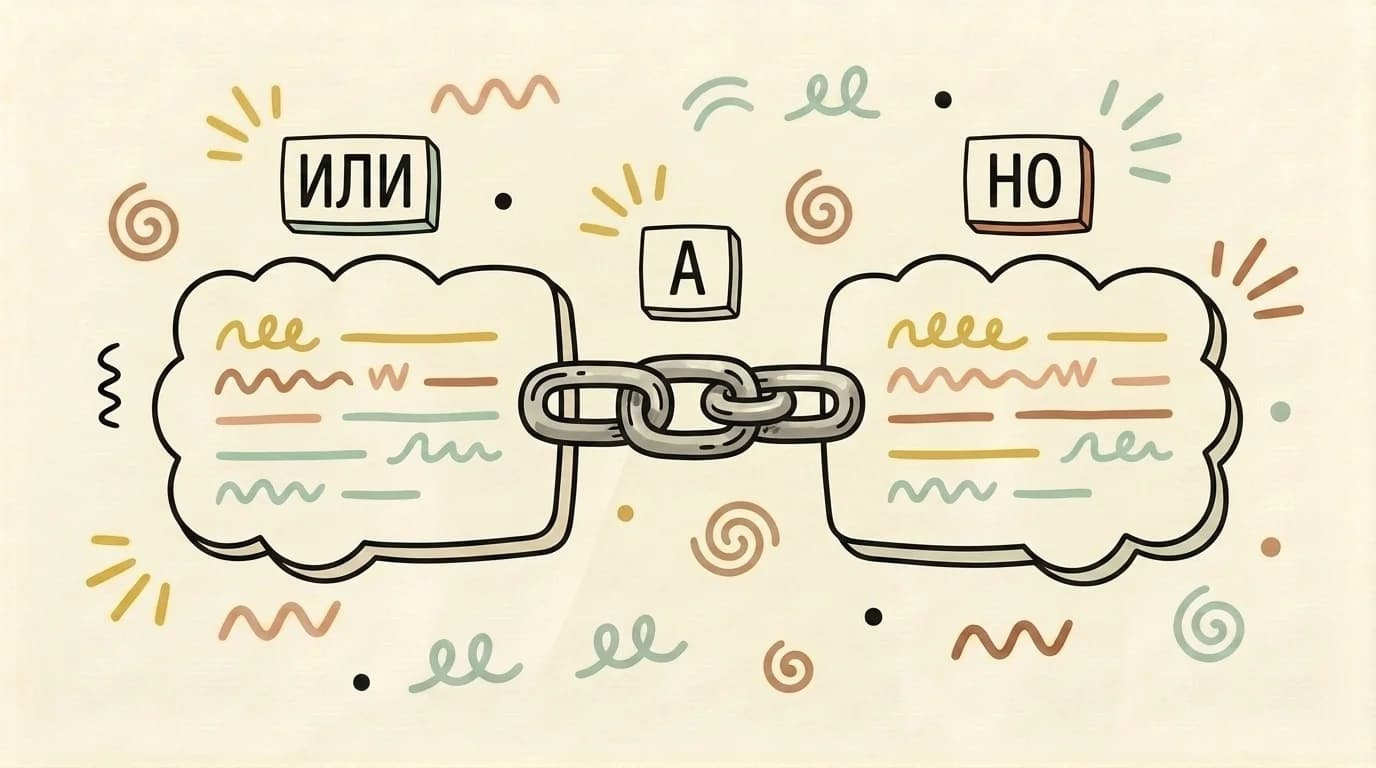
А (a, “and/but”) — The Contrast King
This is where Russian gets interesting. А is not exactly “but.” It’s softer. You use it when you’re switching topics or contrasting two things without a strong opposition.
Я люблю чай, а он кофе(ya lyublyu chay, a on kofe) — “I love tea, and he (on the other hand) loves coffee.”
Think of А as “meanwhile” or “as for.” It’s perfect for comparing people, preferences, or situations. If you use но (no, “but”) here, it sounds like there’s a conflict. А just states a difference.
Но (no, “but”) — The Real “But”
Save но for actual contradictions or obstacles.
Я хотел пойти, но устал(ya khotel poyti, no ustal) — “I wanted to go, but I’m tired.”
Но is stronger than а. Use it when one idea pushes against the other.
Тоже and Также (tozhe, takzhe — “also, too”)
Тоже is for when you’re adding yourself or someone to a statement that already exists.
Я тоже люблю собак(ya tozhe lyublyu sobak) — “I also love dogs (too).”
Также is more formal and works for adding actions or ideas.
Он также изучает французский(on takzhe izuchayet frantsuzskiy) — “He is also studying French.”
Tip: If you’re agreeing with someone, use тоже. If you’re listing additional facts, use также. Mixing them up won’t break the conversation, but natives will notice.
Connectors That Buy You Time and Keep the Flow
Ну (nu, “well”) — The Swiss Army Knife
Ну is everywhere. It starts sentences, shows hesitation, softens commands, and expresses impatience. It’s like “well” but more versatile.
Ну, не знаю(nu, ne znayu) — “Well, I don’t know.”Ну давай(nu davay) — “Well, come on / let’s go.”
You can also use ну to mean “so” when you’re concluding something: Ну, пошли (nu, poshli) — “So, let’s go.”
В общем (v obshchem, “in general / basically”) — Your Summary Tool
When you’ve been rambling and want to wrap up, drop в общем.
В общем, мы опоздали(v obshchem, my opozdali) — “Basically, we were late.”
It’s also great for restarting a story after a tangent. Think of it as “anyway” in English.
Кстати (kstati, “by the way”) — The Topic Shifter
Perfect for casual conversation when you remember something related but not central.
Кстати, ты видела новый фильм?(kstati, ty videla novyy film?) — “By the way, did you see the new movie?”
It feels natural and keeps the chat from being too linear. Use it often.
Connectors for Arguments and Opinions
На самом деле (na samom dele, “actually / in fact”) — The Reality Check
When you want to correct a misconception or add a surprising truth.
На самом деле, он не уехал(na samom dele, on ne uyekhal) — “Actually, he didn’t leave.”
It’s stronger than вообще (voobshche, “generally”) and works well in debates or when you’re clarifying.
Ведь (ved’, “after all / you see”) — The Explainer
Ведь is subtle. It’s used when you’re reminding someone of an obvious reason or justifying something.
Не волнуйся, ведь я с тобой(ne volnuysya, ved’ ya s toboy) — “Don’t worry, after all, I’m with you.”
It adds a layer of “you should already know this.” Use it carefully — it can sound a bit patronizing if overused.
Хотя (khotya, “although / though”) — The Soft Contradiction
Хотя lets you introduce an opposing idea without shutting down the first one. It’s great for nuance.
Фильм был длинный, хотя интересный(fil’m byl dlinnyy, khotya interesnyy) — “The movie was long, although interesting.”
You can also use it at the end of a sentence like “though” in English: Он умный. Я с ним не согласна, хотя (on umnyy. Ya s nim ne soglasna, khotya) — “He’s smart. I don’t agree with him, though.”
Tip: Practice хотя at the end of sentences. It sounds very natural and is often missed by learners.
Putting Connectors Together in Real Conversation
Let’s see how these work in a short exchange.
You’re telling a friend about your weekend.

Ну, в субботу я хотел пойти в кино, но передумал. Кстати, ты смотрела тот новый детектив? На самом деле, я не очень люблю детективы, хотя иногда смотрю. В общем, остался дома и читал книгу. А ты что делала?
Translation: “Well, on Saturday I wanted to go to the cinema, but I changed my mind. By the way, did you see that new detective movie? Actually, I don’t really like detective stories, although I watch them sometimes. Anyway, I stayed home and read a book. And what did you do?”
Notice how ну starts the story, кстати shifts to a question, на самом деле corrects an assumption, хотя softens the contradiction, and в общем wraps it up. Without these, the story would feel like a list. With them, it’s a conversation.
Cultural Context: Connectors in Russian Music and Film
You’ll hear these everywhere once you start listening for them. In Zemfira’s song Искала (Iskala, “Searched”), she uses ведь to justify her emotions: Ведь я искала тебя (Ved’ ya iskala tebya, “After all, I was looking for you”). It adds a pleading, explanatory tone.
In the film Брат (Brat, “Brother”), the main character Danila uses ну constantly. It makes him sound casual, a bit tired, and very Russian. Watch a scene with subtitles and count how many times ну appears. You’ll be surprised.
If you’re into stand-up, comedians like Slava Komissarenko use кстати and в общем as transitional tools between jokes. It’s the same rhythm you’d hear in English with “anyway” or “so.”
Common Mistakes to Avoid
Mistake 1: Using но when you mean а.
If you’re just comparing two things without conflict, use а. Я высокий, а он низкий (ya vysokiy, a on nizkiy) — “I’m tall, and he is short.” Using но here sounds like you’re saying “I’m tall, but he is short” which implies a problem. It’s not wrong, but it’s clunky.
Mistake 2: Overusing и at the start of sentences.
In English, starting with “And” is common in speech. In Russian, it’s fine, but if you do it too much, you sound like a child telling a story. Alternate with ну or а.
Mistake 3: Translating “actually” directly as актуально.
Актуально means “relevant” or “topical,” not “actually.” Use на самом деле or вообще instead. This is a classic false friend.
Heads up: Вообще (voobshche) has multiple meanings. It can mean “generally,” “at all,” or “actually” depending on context. Я вообще не люблю кофе (ya voobshche ne lyublyu kofe) — “I don’t like coffee at all.” Вообще, это интересно (voobshche, eto interesno) — “Actually, this is interesting.” Listen to how natives use it before you try it yourself.
How to Practice Without Drills
The best way to get connectors into your speech is to shadow native speakers. Pick a short YouTube video — a vlog, a podcast, or a movie scene. Listen to a sentence, pause, and repeat it exactly, focusing on the connectors. Don’t worry about the whole sentence at first. Just get the rhythm of ну, кстати, в общем.
Another trick: write a short paragraph about your day in English, then translate it into Russian. But don’t just translate word for word. Ask yourself: “Would a Russian speaker use а here? Should I start with ну?” Rewrite it until it sounds natural.
If you want more personalized feedback, that’s exactly what I do in my 1-on-1 online lessons. We can work on real conversations — ordering coffee, arguing about movies, telling stories — and I’ll correct your connectors in real time. No drills, just talking.
Try This Today
Pick one of these mini-tasks and do it right now. Don’t overthink.
-
Record yourself telling a 30-second story about your morning. Use at least three different connectors from this list. Listen back. Does it flow?
-
Find a Russian song you like. Write down the first four lines. Circle every connector you see. Notice how they change the tone.
-
Text a friend (or yourself) in Russian. Write three sentences about your weekend plans. Use
кстатиin one,ноin another, andаin the third. -
Watch a 2-minute clip from a Russian movie or vlog (try “вДудь” interviews or “Кухня” series). Count how many times the speaker says
ну. That’s your new benchmark. -
Rewrite this sentence in a more natural way:
Я люблю собак. Я люблю кошек. Я не люблю рыбок.(I love dogs. I love cats. I don’t love fish.) Add connectors to make it a single, flowing sentence.
You don’t need to master all of them at once. Pick two connectors this week — maybe ну and кстати — and force yourself to use them in every Russian sentence you say. After seven days, they’ll feel like your own. Then add another pair.
Your Russian will never sound like a textbook again.