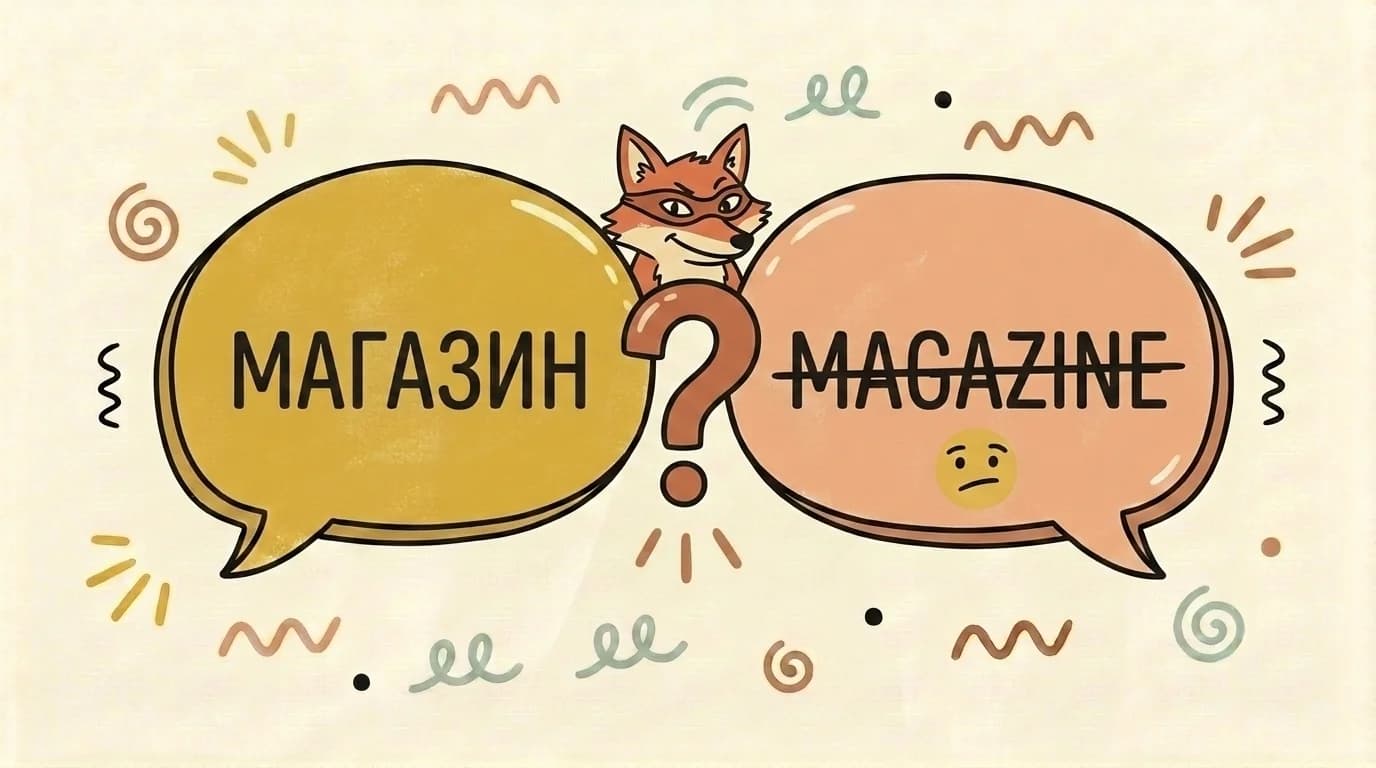
You finally work up the courage to say "I'm going to the store" in Russian to your friend, and they burst out laughing. You thought you said "магазин" (magazin), which is "shop." But somehow they heard "magazine," like a glossy publication. You didn't mess up the grammar. You hit a false friend — a word that looks or sounds like English but means something completely different. These traps are everywhere in Russian, and they make even advanced learners stumble. Let's walk through the worst offenders so you can spot them before they embarrass you.
What kind of player are you really?
The Classic "Magazine" Trap
Let's start with the one that trips up almost everyone on day one. The word магазин (magazin) sounds exactly like "magazine" in English. But in Russian, it means a store or shop. A grocery store is продуктовый магазин (produktovyy magazin). A clothing store is магазин одежды (magazin odezhdy). A magazine, the thing you read, is журнал (zhurnal). So if you tell someone you're going to the magazine, they'll picture you walking into a supermarket to flip through pages. Awkward.
Tip: When you see a Russian word that looks like an English word, assume it's a false friend until proven otherwise. The real meaning is often more mundane or completely unrelated.
"Fabrika" Is Not a Fabric Store
You see фабрика (fabrika) and think "fabric." Makes sense, right? Fabric comes from a factory. But in Russian, фабрика means a factory or plant — the place where things are made, not the material itself. Fabric, the cloth, is ткань (tkan'). So if you're shopping for sewing supplies and ask for фабрика, people will point you to the industrial district. You want ткань. This is a classic example of a word that shares a Latin root but diverged in meaning. English kept "fabric" as the product, Russian kept "fabrika" as the production site.
"List" Is Not a List
The word лист (list) looks like "list" in English. But it means a sheet of paper or a leaf (from a tree). A list, as in a shopping list, is список (spisok). So if you say "у меня есть лист" (u menya yest' list), you're saying "I have a sheet of paper," not "I have a list." Your friend will wait for you to write something down. This one is extra tricky because the plural листы (listy) means sheets of paper, but листья (list'ya) means leaves on a tree. Same root, different plural forms, different meanings.
"Dacha" Is Not a Dance
You hear дача (dacha) and think "dacha" is a loanword in English for a Russian country house. That's actually correct — English borrowed it. But the trap is that dacha in Russian also means a "dacha" as in the house, but the word itself comes from the verb давать (davat', "to give"). Historically, it was land given by the tsar. So no dance involved. But the real false friend danger is when you confuse dacha with the word for "date" (as in calendar date or romantic date). That's дата (data). Or with "daughter," which is дочь (doch'). So if you say "I'm going to my dacha," everyone understands. If you say "I'm going to my data," they'll be confused. Keep them straight.
"Kartofel" Is Not a Card Game
Картофель (kartofel') sounds like "card" or "carton" to an English ear. But it means potato. The word for card is карта (karta) or карточка (kartochka). So if you're at a restaurant and say "I'd like the картофель," you're ordering potatoes, not playing cards. This one is easy to mix up because the stress is on the second syllable: kar-TO-fel'. The English word "carton" is closer in sound, but still not the same. Just remember: картофель is food, карта is plastic or paper.
Heads up: False friends often cluster around food and everyday objects. If a Russian word sounds like an English word for a household item, double-check. It's probably something you eat or wear instead.
"Shashlik" Is Not a Hat
You've probably heard шашлык (shashlyk) — it's a skewered meat dish, like kebab. But the false friend here is subtle. In English, "shashlik" is a loanword, so it's fine. The trap is when you hear a similar-sounding word like шляпа (shlyapa), which means hat. Or шарф (sharf), which means scarf. So if you're at a barbecue and say "Pass me the shashlik," you're good. If you say "Pass me the shlyapa," you'll get a hat. Not edible.
"Puk" Is Not a Fart
This one is pure gold. The Russian word пук (puk) means a fart. Yes, it sounds exactly like the English word "pook" or "puck," but it's not a hockey puck. It's a bodily function. The word for hockey puck is шайба (shayba). So be careful. If you're playing hockey and yell "Pass the puk," your Russian teammates will either laugh or be horrified. This is a small word but a big trap. Also note: the verb пукать (pukat') means to fart. Not a word you want to mix up in polite company.
"Bulka" Is Not a Bull
Булка (bulka) sounds like "bull" but it means a bread roll or bun. A bull is бык (byk). So if you're at a bakery and ask for a bull, you'll get a confused stare. If you ask for a bulka, you'll get a soft, round bread. This is a great example of how false friends can be misleading because of similar consonant clusters. English "bull" has a dark L, Russian "bulka" has a soft L. But to a beginner, they sound close enough to cause confusion.
"Stol" Is Not a Stool
Стол (stol) means table. A stool is табурет (taburet) or стул (stul, which means chair). So if you say "sit on the stol," you're asking someone to sit on a table. That's weird. The word for stool in English is not directly related to the Russian word. This is a classic false friend because the English "stool" and Russian "stol" share a common Proto-Indo-European root (meaning "to stand"), but they evolved differently. English kept "stool" as a seat, Russian kept "stol" as a table.
"Dym" Is Not a Dime
Дым (dym) means smoke. A dime, the coin, is дайм (daym) in Russian, borrowed from English. So if you say "I have a dym," you're saying "I have smoke," not "I have a dime." This one is easy to mix up because the vowel sound is similar. But in Russian, дым is a masculine noun, and it's a common word for smoke from a fire, cigarette, or chimney. The English "dime" is a loanword that only appears in financial contexts. So unless you're talking about money, stick with дым for smoke.
How to Survive False Friends
The key is to build a mental "danger list" of words that look like English but aren't. Start with the ones above. Then, as you learn, notice when a word feels too familiar. That's usually the moment to pause and verify. Use a good dictionary like Wiktionary or Reverso Context to see example sentences. Don't just trust your instinct.
Another trick: pay attention to word families. If you know магазин (magazin) is a store, then you know магазинный (magazinnyy) means "store-related." If you know лист (list) is a sheet, then листок (listok) is a small sheet or a leaflet. False friends often have predictable derivatives, so learning the root helps you avoid the trap.
Finally, embrace the mistakes. I've heard students order "a table of smoke" (стол дыма) instead of "a table for smoking" (стол для курения). It's funny, and you remember it. The embarrassment fades, but the word sticks.
Try This Today
Here are 5 mini-tasks to practice spotting false friends.
-
Match the false friend. Write down the Russian word for "magazine" (the publication) and "magazine" (the store). Say both out loud three times.
-
Translate this sentence: "I need a list of sheets of paper." Use the correct Russian words for "list" and "sheet."
-
Roleplay a shopping trip. Imagine you're at a bakery. What do you say to order a bread roll? What if you accidentally say "bull"? Write both phrases.
-
Spot the trap. Read this sentence: "On the table, there is smoke and a potato." Is there a false friend here? If so, which word is the trap?
-
Create your own false friend. Think of an English word that sounds like a Russian word you know. Write a short dialogue where the confusion happens. For example: "I put the hat on the stove" (шляпа vs. шкаф? No, шкаф is cupboard. But you get the idea).
If you want to go deeper, I teach 1-on-1 online lessons where we focus on real conversation and these sneaky traps. We'll laugh at the mistakes and build your confidence so you never confuse a potato with a card game again. For now, start with these five tasks. You'll be surprised how quickly your brain rewires to catch false friends.