You open a Russian text, ready to decode it. Your brain starts scanning for familiar shapes. And then you see it: проблема (problema). You smile. That's "problem." Then ресторан (restoran). "Restaurant." Then компьютер (kompyuter). You don't even need to think. Suddenly, the wall of Cyrillic doesn't look so scary. You already know dozens of Russian words. You just didn't realize it.
What kind of player are you really?
The Cognate Cheat Code
Cognates are words that share a common origin across languages. Russian and English are both Indo-European languages, but they also borrowed heavily from Latin, Greek, and French at different points. The result is a hidden layer of vocabulary that looks almost identical to English, just wearing a Cyrillic costume. You don't need to memorize these. You need to recognize them.
The trick is learning the sound shifts and spelling patterns. Once you see how English endings like "-tion" become -ция (-tsiya) or "-ic" becomes -ический (-icheskiy), you can guess hundreds of words with high accuracy.
The Big Patterns: How English Endings Turn Russian
-tion becomes -ция (-tsiya)
This is the most productive pattern. Almost every English word ending in "-tion" has a direct Russian cognate.
информация (informatsiya, "information")
ситуация (situatsiya, "situation")
нация (natsiya, "nation")
операция (operatsiya, "operation")
станция (stantsiya, "station")
организация (organizatsiya, "organization")
революция (revolyutsiya, "revolution")
The stress usually falls on the last syllable, like in English. Just drop the "-tion" and add "-ция."
-ic or -ical becomes -ический (-icheskiy)
Words describing styles, fields, or characteristics.
энергичный (energichnyy, "energetic")
исторический (istoricheskiy, "historical")
политический (politicheskiy, "political")
экономический (ekonomicheskiy, "economic")
академический (akademicheskiy, "academic")
электрический (elektricheskiy, "electric")
Tip: If you see -ический at the end of a word, read it as "-ical" or "-ic." Your brain will adjust quickly.
-ist becomes -ист (-ist)
Professions and people who do things.
журналист (zhurnalist, "journalist")
пианист (pianist, "pianist")
турист (turist, "tourist")
специалист (spetsialist, "specialist")
коммунист (kommunist, "communist")
оптимист (optimist, "optimist")
The pattern is almost identical. The only difference is the Cyrillic spelling and a slightly different pronunciation of the vowel.
-er or -or becomes -ер (-er) or -ор (-or)
доктор (doktor, "doctor")
профессор (professor, "professor")
директор (direktor, "director")
актёр (aktyor, "actor")
режиссёр (rezhissyor, "director" in film)
менеджер (menedzher, "manager")
тренер (trener, "trainer/coach")
Pay attention to the ё (yo) in words like актёр. It's a different letter than е. But the word is still instantly recognizable.
Everyday Objects and Concepts
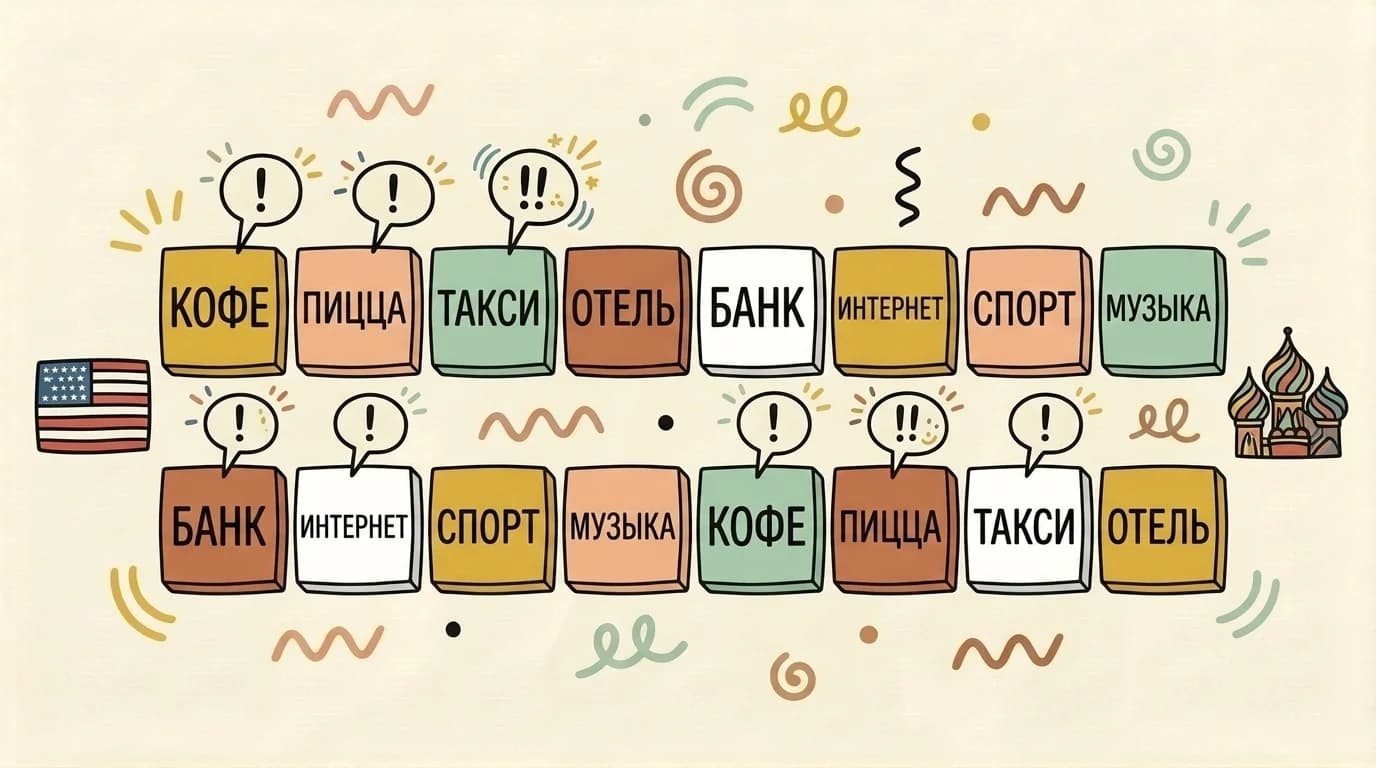
These are words you see in daily life, from menus to street signs.
ресторан (restoran, "restaurant")
кафе (kafe, "café")
меню (menyu, "menu")
пицца (pizza, "pizza")
салат (salat, "salad")
суп (sup, "soup")
кофе (kofe, "coffee")
чай (chay, "tea")
шоколад (shokolad, "chocolate")
маркет (market, "market" – but often used for supermarkets)
банк (bank, "bank")
офис (ofis, "office")
такси (taksi, "taxi")
автобус (avtobus, "bus")
метро (metro, "subway/metro")
парк (park, "park")
музей (muzey, "museum")
театр (teatr, "theater")
кино (kino, "cinema/movie")
музыка (muzyka, "music")
радио (radio, "radio")
телефон (telefon, "telephone")
компьютер (kompyuter, "computer")
интернет (internet, "internet")
Heads up: чай (chay) is "tea," not "chai" as in the spiced drink. In Russia, чай is just regular tea. If you want chai tea, you'd say чай с пряностями (chay s pryanosyami, "tea with spices").
Academic and Abstract Words
If you studied science, history, or philosophy, you have a huge head start.
теория (teoriya, "theory")
идея (ideya, "idea")
система (sistema, "system")
метод (metod, "method")
анализ (analiz, "analysis")
синтез (sintez, "synthesis")
результат (rezultat, "result")
факт (fakt, "fact")
концепция (kontseptsiya, "conception/concept")
гипотеза (gipoteza, "hypothesis")
элемент (element, "element")
структура (struktura, "structure")
функция (funktsiya, "function")
процесс (protsess, "process")
программа (programma, "program")
проект (proyekt, "project")
дискуссия (diskussiya, "discussion")
аргумент (argument, "argument")
конфликт (konflikt, "conflict")
компромисс (kompromiss, "compromise")
Notice how процесс (protsess) has a double с (s) at the end. Russian often doubles consonants in borrowed words, but the pronunciation is still clear.
Arts, Culture, and Entertainment
Russian culture has its own words, but many international terms are direct loans.
фильм (fil'm, "film")
сериал (serial, "TV series")
режиссёр (rezhissyor, "director")
сценарий (stsenariy, "scenario/script")
актёр (aktyor, "actor")
актриса (aktrisa, "actress")
спектакль (spektakl', "spectacle/performance")
балет (balet, "ballet")
опера (opera, "opera")
джаз (dzhaz, "jazz")
рок (rok, "rock music")
поп-музыка (pop-muzyka, "pop music")
фестиваль (festival', "festival")
выставка (vystavka, "exhibition" – from "выставить," to exhibit)
галерея (galereya, "gallery")
музей (muzey, "museum")
архитектура (arkhitektura, "architecture")
If you love movies, you can already read half a Russian film review. Фильм is "film," режиссёр is "director," сценарий is "script." Put them together and you're discussing новый фильм Квентина Тарантино (novyy fil'm Kventina Tarantino, "new Quentin Tarantino film").
False Friends: The Ones That Trick You
Not every word that looks like English means what you think. A few common traps.
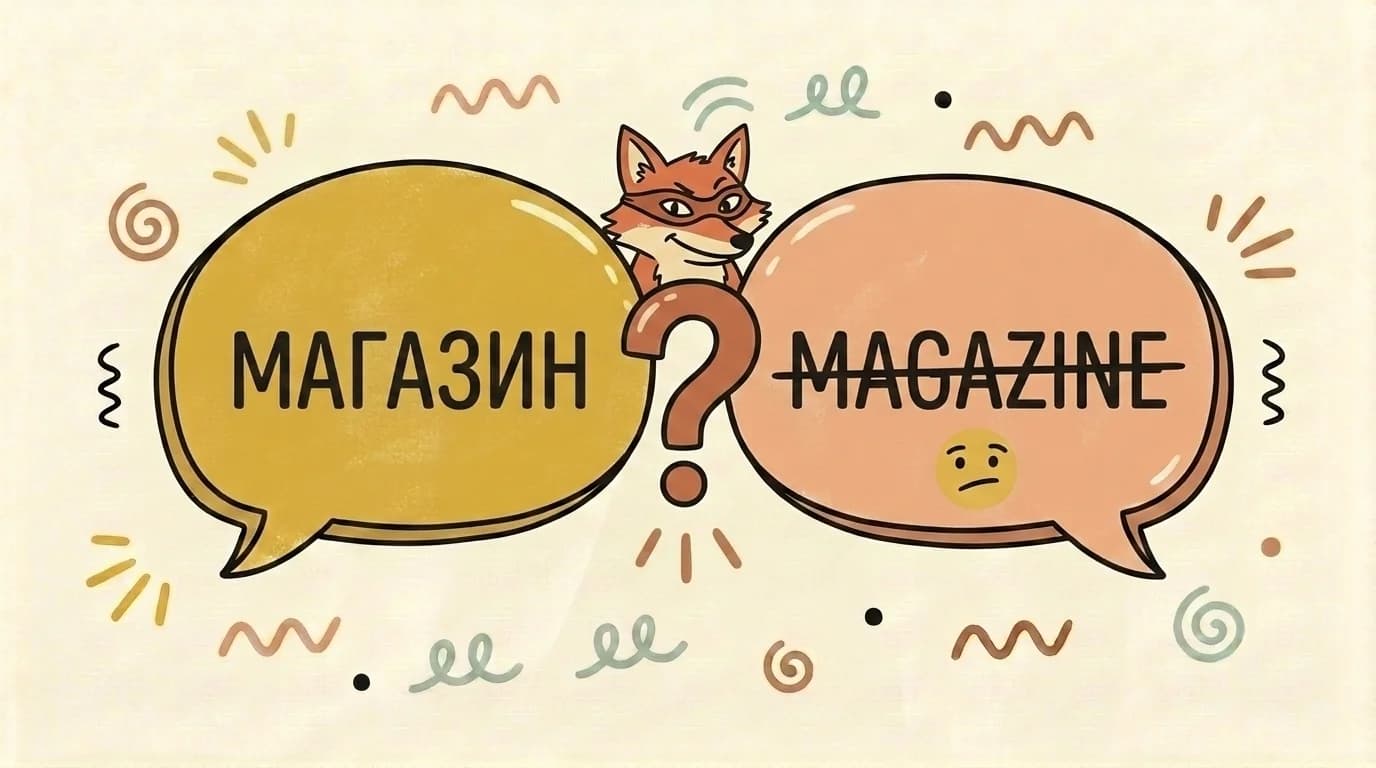
магазин (magazin, "shop/store") – not "magazine." A magazine is журнал (zhurnal).
семья (sem'ya, "family") – not "seminar." Sounds like "semi-ya," but it's family.
фамилия (familiya, "surname/last name") – not "family." Your family name is your фамилия.
ткань (tkan', "fabric") – not "tank." A tank is танк (tank).
лук (luk, "onion" or "bow" for arrows) – not "look." To look is смотреть (smotret').
Tip: When you see a word that looks like English, say it out loud in Russian pronunciation. If it sounds different, double-check the meaning. Магазин sounds like "muh-gah-ZEEN" with stress on the last syllable. That's a store, not a magazine.
How to Start Using Cognates Today
You don't need flashcards for these words. You need exposure. Read a Russian menu, watch a Russian movie trailer with subtitles, or scroll through a Russian news headline. Your brain will start matching patterns automatically.
Here is a quick list of 50 cognates you can recognize right now. Read them aloud in Russian pronunciation.
проблема(problema) – problemресторан(restoran) – restaurantкомпьютер(kompyuter) – computerинформация(informatsiya) – informationситуация(situatsiya) – situationнация(natsiya) – nationоперация(operatsiya) – operationстанция(stantsiya) – stationорганизация(organizatsiya) – organizationреволюция(revolyutsiya) – revolutionэнергичный(energichnyy) – energeticисторический(istoricheskiy) – historicalполитический(politicheskiy) – politicalэкономический(ekonomicheskiy) – economicжурналист(zhurnalist) – journalistтурист(turist) – touristспециалист(spetsialist) – specialistдоктор(doktor) – doctorпрофессор(professor) – professorдиректор(direktor) – directorактёр(aktyor) – actorменеджер(menedzher) – managerкафе(kafe) – caféменю(menyu) – menuпицца(pizza) – pizzaсалат(salat) – saladсуп(sup) – soupкофе(kofe) – coffeeшоколад(shokolad) – chocolateмаркет(market) – marketбанк(bank) – bankофис(ofis) – officeтакси(taksi) – taxiавтобус(avtobus) – busметро(metro) – subwayпарк(park) – parkмузей(muzey) – museumтеатр(teatr) – theaterкино(kino) – cinemaмузыка(muzyka) – musicтелефон(telefon) – telephoneинтернет(internet) – internetтеория(teoriya) – theoryидея(ideya) – ideaсистема(sistema) – systemанализ(analiz) – analysisрезультат(rezultat) – resultфакт(fakt) – factфильм(fil'm) – filmсериал(serial) – TV series
Try This Today
You already have a vocabulary of 50+ words. Now use them.
-
Find a Russian menu online. Look for a restaurant menu from Moscow or St. Petersburg. Count how many words you can read without a dictionary. You should spot
ресторан,меню,салат,суп,пицца,кофе,шоколад,десерт(desert, "dessert"). -
Watch a Russian movie trailer on YouTube. Search for "трейлер фильма" (treyler fil'ma, "movie trailer") plus the name of a Hollywood movie you know. Listen for words like
фильм,режиссёр,актёр,сценарий. You will understand the gist. -
Read a Russian news headline. Go to a site like lenta.ru or ria.ru. Look for headlines with words like
президент(prezident, "president"),политика(politika, "politics"),экономика(ekonomika, "economy"),проблема,результат. You will be surprised how much you get. -
Translate five cognates into a sentence. Take any five words from the list above and write a short Russian sentence. For example:
Я люблю пиццу и кофе(Ya lyublyu pizzu i kofe, "I love pizza and coffee"). It's grammatically simple, but it's real Russian. -
Spot the false friends. Walk through a Russian text and find three words that look like English but mean something different. Write them down with the correct meaning. This will save you from embarrassing mistakes later.
If you want to practice these words in real conversation with a native speaker, I teach 1-on-1 online lessons. We skip drills and talk about things that actually interest you. Music, movies, travel, whatever you like. You already have 50 words. Let's use them.