You've been studying Russian for a few months. You know how to say "My name is" and "I like cats." Then a Russian friend says, "We're going to the dacha this weekend, then hitting the banya." You nod, smile, and have absolutely no idea what just happened.
What kind of player are you really?
It's not your fault. Textbooks teach you grammar drills, not how to talk about the things that actually fill a Russian weekend. If you want to chat like a real person, you need to know the cultural furniture of everyday life. The dacha. The banya. The kitchen table that turns into a three-hour conversation. These aren't just words. They are the rooms where relationships happen.
The Dacha: Not a House, a State of Mind
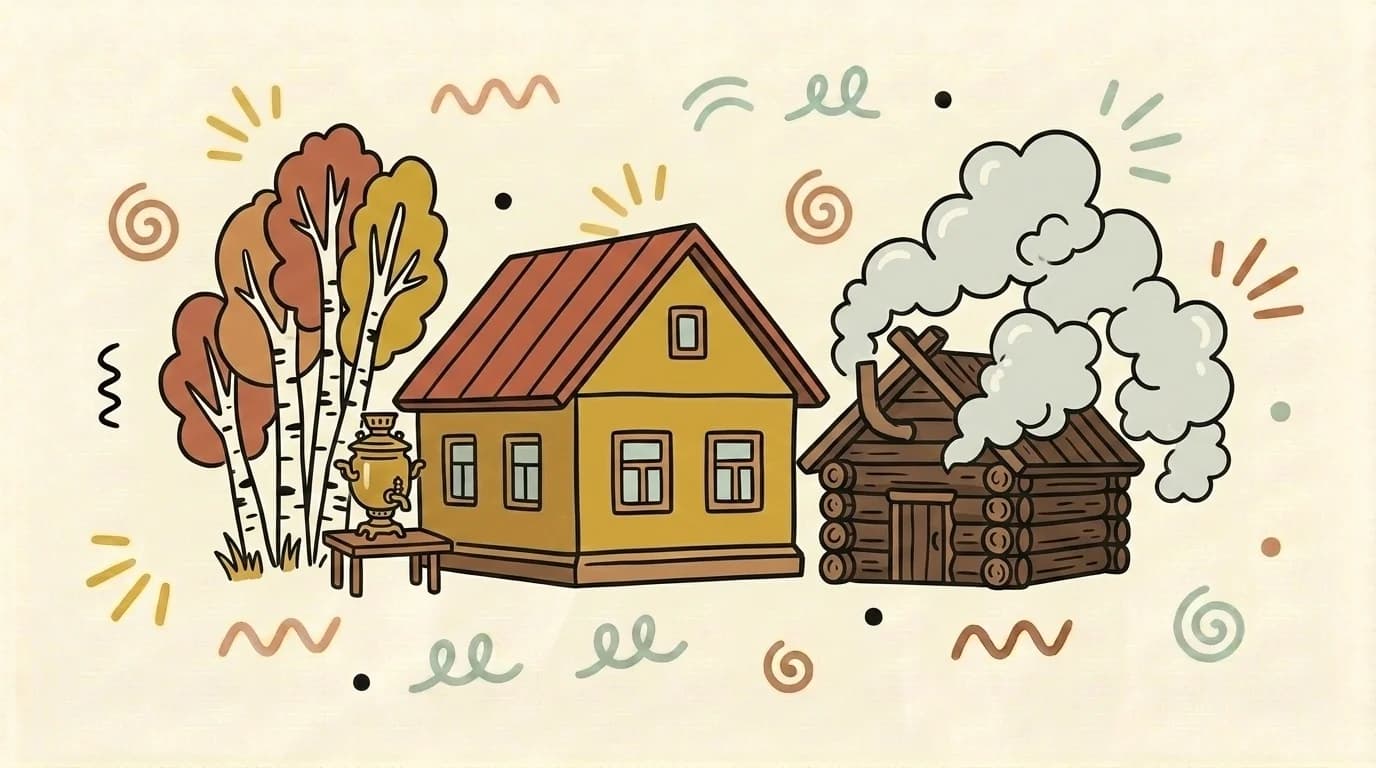
If you say "I have a summer house," an American imagines a beach cottage or a lake cabin. If you say "I have a дача (dacha, "summer cottage")," a Russian imagines a small wooden structure with a leaking roof, a vegetable patch, and a profound sense of peace.
The dacha is not about luxury. It is about escape. For decades, city dwellers in the Soviet Union used their tiny plots of land to grow food, pickle cucumbers, and breathe air that didn't taste like bus exhaust. Today, the tradition is alive and well. Millions of Russians spend every warm weekend at their dacha, planting potatoes, repairing fences, and drinking tea on a crooked porch.
You will hear phrases like:
- Едем на дачу (yedem na dachu, "we're going to the dacha")
- Убирать урожай (ubirat' urozhay, "to harvest the crop")
- Шашлыки на даче (shashlyki na dache, "barbecue at the dacha")
The dacha is also a social hub. You don't go alone. You bring friends, neighbors, and anyone who happens to be standing nearby. The unspoken rule is simple: if you show up at a dacha, you will be fed. Probably with something pickled.
Tip: When a Russian invites you to their dacha, say yes. Even if you hate gardening. The real activity is sitting around a table for four hours talking about everything and nothing. The vegetables are just props.
The Banya: Sweat, Whack, Repeat
The баня (banya, "Russian sauna") is not a spa. It is not a gym sauna. It is a ritual that involves extreme heat, cold plunges, and being hit with wet birch branches by a friend. Yes, on purpose.
Here is how it works. You enter a hot wooden room, temperature around 80 to 100 degrees Celsius. You sit on a bench. You sweat. Then someone takes a веник (venik, "bundle of birch twigs") and gently (or not so gently) whacks your back with it. This is not punishment. It stimulates blood circulation and smells like a forest.
Then you run outside and jump into a cold lake, a snowdrift, or a bucket of ice water. Your body screams. Your mind goes quiet. Then you go back inside and do it again.
The banya is deeply social. Friends and families go together. It is normal to see strangers in the same steam room. People talk, laugh, and pour kvass on the hot stones for the smell. Afterward, you drink tea or beer and eat something simple like boiled potatoes or dried fish.
Key vocabulary:
- Париться (parit'sya, "to steam oneself")
- Веник (venik, "bundle of birch twigs")
- Парная (parnaya, "steam room")
- Окунуться в прорубь (okunut'sya v prorub', "to plunge into an ice hole")
Heads up: If you are invited to a banya, do not wear a swimsuit made of thick fabric. It feels uncomfortable in the heat. A simple towel or a thin cotton sheet is better. Also, do not be surprised if people walk around without clothes. It is not sexual. It is practical.
The Kitchen Table: Where the Real Conversations Happen
Russians do not meet for coffee. They meet for чай (chay, "tea") and that means sitting at a kitchen table for two to four hours. The table is small. The cups are small. The conversations are huge.
A typical kitchen table gathering includes:
- A kettle that is refilled three times
- A plate of печенье (pechen'ye, "cookies") or конфеты (konfety, "candy")
- Someone's grandmother's jam
- A heated debate about politics, life, or why a certain movie is overrated
The kitchen table is where trust is built. You do not need a fancy restaurant. You need a clean tablecloth and a willingness to listen. If a Russian invites you to their kitchen, they consider you family.
You might hear:
- Садись, чай пить (sadis', chay pit', "sit down, have some tea")
- Ещё по одной? (yeshchyo po odnoy?, "one more cup?")
- Давай по душам (davay po dusham, "let's talk heart to heart")
This is not small talk. This is real talk. Be ready to share something genuine.
The "Maybe Yes" Culture: Да нет, наверное
One of the most confusing things for learners is how Russians say "no" while sounding like they are saying "yes." The phrase да нет, наверное (da net, navernoye, "yes no, probably") is a masterpiece of linguistic ambiguity.
It means: "I don't think so, but I'm being polite about it." Or "I'm not sure, but I'm leaning toward no." Or "I don't want to say no directly, so I'll confuse you instead."
You will hear this in everyday situations:
- "Would you like more soup?" "Да нет, наверное." (Translation: No, thank you, but I appreciate the offer.)
- "Can you finish this work today?" "Да нет, наверное." (Translation: Probably not, but I don't want to sound rude.)
The key is to listen to tone. If the person says it quickly and looks away, it is a soft no. If they say it slowly and shrug, it might actually mean "maybe."
Tip: Do not use this phrase until you are comfortable with Russian ambiguity. Learners who try it too early often sound like they are having a stroke. Stick to clear "да" and "нет" until you feel the rhythm.

Vodka: The Social Lubricant (Not a Weapon)
Vodka has a reputation. Yes, Russians drink it. No, they do not drink it the way movies show. You do not chug a bottle and break a glass. You drink small shots, slowly, with food, and usually only on special occasions.
The ritual goes like this. Someone pours. Someone makes a тост (tost, "toast"). Everyone clinks glasses, looks each other in the eye (this is important), and drinks. Then you eat something salty or sour, like a pickle or a piece of bread with salo.
Common toasts:
- За встречу (za vstrechu, "to our meeting")
- За здоровье (za zdorov'ye, "to health")
- За любовь (za lyubov', "to love")
You are never forced to drink. If you do not want vodka, you can say:
- Я не пью (ya ne p'yu, "I don't drink")
- Я за рулём (ya za rulyom, "I'm driving")
If you say either of these, a good host will offer tea or juice instead. If they push, they are not a good host.
The "You Call Me" Dance: A Lesson in Indirect Communication
In many English-speaking cultures, "Let's hang out sometime" is a polite nothing. In Russian culture, it can mean something or nothing, depending on who says it.
If a Russian says:
- Позвони мне (pozvoni mne, "call me")
- Напиши (napishi, "text me")
They might genuinely mean it. Or they might be ending the conversation politely. The trick is to look at their body language and energy. If they smile and linger, they want to see you again. If they say it while walking away, it is a social exit.
To make a real plan, say:
- Давай встретимся в субботу (davay vstretimsya v subbotu, "let's meet on Saturday")
- Я позвоню тебе завтра (ya pozvonyu tebe zavtra, "I'll call you tomorrow")
If you say "I'll call you," do call. Russians remember these things.
Try This Today
You do not need to be in Russia to practice these cultural skills. Try these mini-tasks this week:
-
Plan a virtual kitchen table. Call a Russian-speaking friend or language partner. Ask them about their favorite family recipe. Let the conversation wander for at least 30 minutes. Do not rush. This is the kitchen table, not a business meeting.
-
Learn one dacha phrase. Write down "Едем на дачу" (yedem na dachu) and practice saying it out loud. Imagine yourself in a car with friends, heading out of the city. Feel the anticipation.
-
Watch a banya scene. Find a clip from the Russian movie "Ирония судьбы" (Ironiya sud'by, "The Irony of Fate") where the characters go to a banya. Notice how they talk, laugh, and interact. It is a comedy classic and full of real cultural moments.
-
Practice "Да нет, наверное." Stand in front of a mirror. Say the phrase three times with different tones: unsure, polite, and dismissive. Record yourself. Listen. This is not for perfection. It is for feeling the shape of the phrase.
-
Invite someone for чай. Send a message to a friend or language partner and say "Давай попьём чай" (davay pop'yom chay, "let's have tea"). If they say yes, set a time. If they say "Да нет, наверное," try again next week.
If you want to practice these conversations in a real, 1-on-1 setting, I teach exactly this kind of Russian. No drills. No textbook sentences about train stations. Just the language you actually need to laugh, argue, and eat pickles with your Russian friends.